
A phishing email arrives just before a supplier payment is due. Someone clicks, enters their Microsoft 365 password and approves a sign-in request without realising that an attacker is watching. Your business may already have Microsoft 365, firewalls and antivirus protection, yet nobody can confidently answer which accounts have excessive permissions, whether Azure logs are being reviewed or how quickly a serious weakness would be fixed.
That uncertainty is where cyber security audit services earn their place. An audit gives business leaders a structured view of current security posture, shows where controls work and where they fail, and turns technical findings into a prioritised plan. For East Midlands SMEs, it can also provide evidence for customers, insurers, tenders and recognised assurance schemes.
Introduction Why Cyber Security Audits Matter Now
A manufacturer in Lincoln, a professional services firm in Nottingham or a distributor near Newark can run efficiently on cloud systems while still carrying hidden cyber risk. Staff may share access through convenience groups, former employees may retain accounts, a supplier may connect remotely and critical Microsoft 365 alerts may go unreviewed. None of these weaknesses necessarily appears in an everyday IT support ticket.
The UK Cyber Security Breaches Survey 2025/2026 estimated that 43% of UK businesses experienced a cyber security breach or attack in the previous 12 months, equivalent to about 612,000 businesses. The same survey found that only 18% of businesses carried out cyber security vulnerability audits, which helps explain why many organisations discover gaps only after an incident. These figures come from the UK government survey data.
An audit works like a health check for the business. It doesn't promise that an organisation can prevent every attack. Instead, it helps leaders understand the condition of their defences before an attacker tests them, while there's still time to improve identity controls, patching, backups, supplier access and incident response.
The practical question isn't whether your business has security tools. It's whether those tools, settings and processes work together when someone targets you.
A useful audit should leave you with more than a list of technical observations. You should know which issues matter most, who owns each corrective action, what evidence proves the fix and when the review should be repeated. The sections that follow build from this basic idea towards audit types, process, UK compliance and provider selection.
What Cyber Security Audit Services Really Cover
Think of your business premises. A sensible security review wouldn't inspect only the front door. It would check who has keys, whether visitors are recorded, whether staff know what to do when a door alarm sounds and whether cameras cover important areas.
A cyber security audit applies the same logic to people, processes and technology. It examines how employees use systems, how the organisation manages risk and whether technical controls are configured and operating consistently.
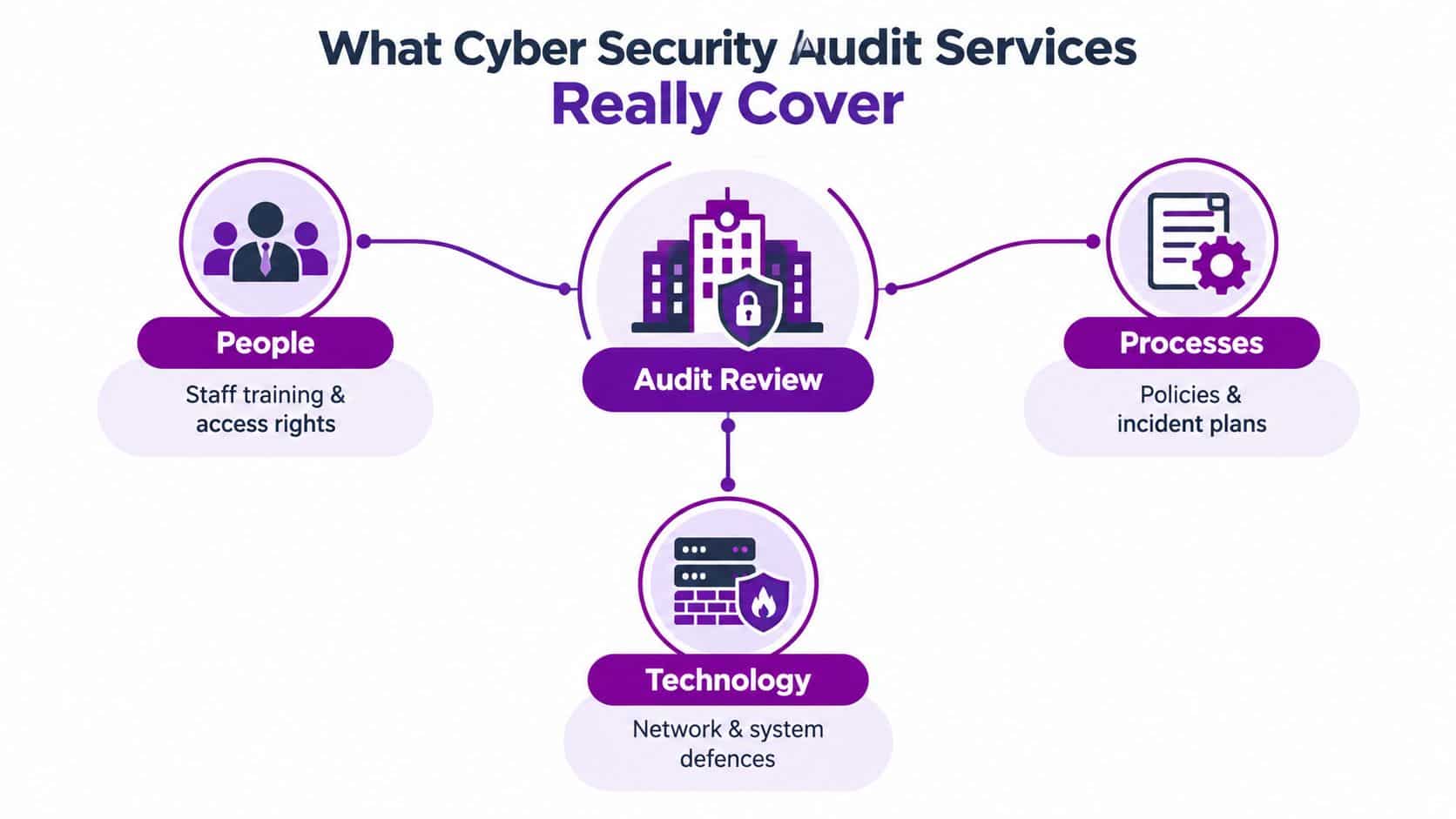
People and access
Auditors may review joiner, mover and leaver procedures, administrator accounts, multi-factor authentication, staff training and third-party access. Role-based access control is particularly useful because it gives people only the permissions their responsibilities require. If your team needs a plain-language explanation, SigFinch's guide to role-based access control offers helpful background.
Processes and evidence
Policies matter, but an auditor also looks for evidence that people follow them. That evidence might include access reviews, incident records, backup test results, vulnerability remediation records, supplier assessments and change approvals. A policy saying that critical issues receive prompt attention isn't enough if the ticket history shows no owner or completion record.
Technology and scope
The technical review can include Microsoft 365 identity settings, Azure configuration, endpoint protection, patch management, firewalls, network segmentation, logging and backup arrangements. The exact scope depends on the business, its systems and the risks it needs to manage.
An audit isn't the same as a vulnerability scan. A scan may identify known weaknesses in a defined technical environment. An audit asks whether the organisation has selected, configured, operated and evidenced appropriate controls. Continuous monitoring is different again. Monitoring watches for events over time, while an audit provides a structured assessment at an agreed point.
A strong audit defines its boundaries clearly. It records what was reviewed, what wasn't reviewed, which evidence was supplied and where judgement was required. That clarity prevents directors from assuming that an audit covers systems or suppliers that were never included.
Understanding the Main Types of Cyber Security Audit
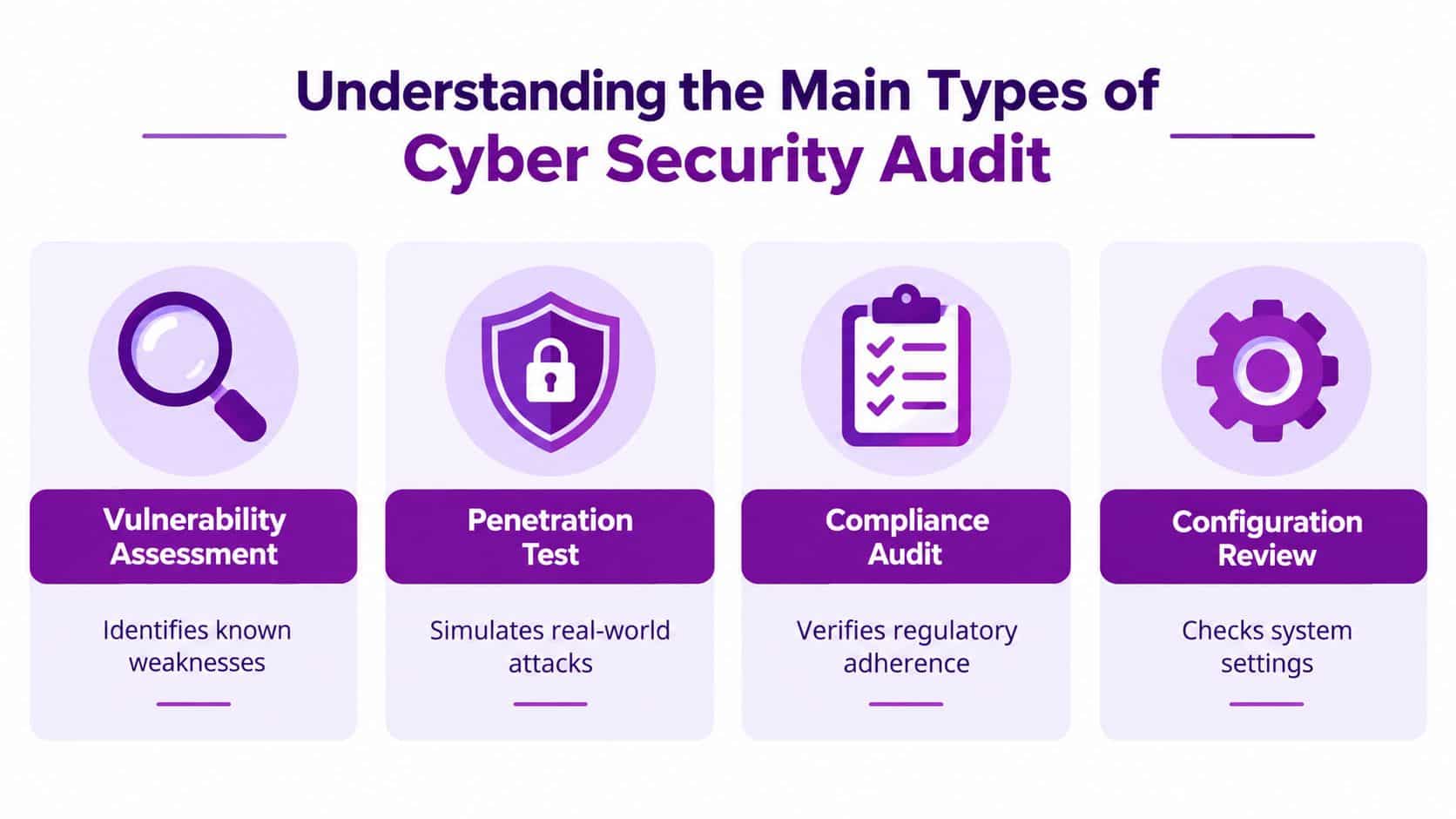
Different audit types answer different questions. A vulnerability assessment asks where known weaknesses exist. A penetration test asks whether those weaknesses, or other attack paths, could be used. A compliance audit tests alignment with a defined requirement, while a configuration review examines whether systems are set up securely.
Four useful lenses
Vulnerability assessment
This is a broad method for identifying known weaknesses across agreed systems. It can help a business understand exposure across endpoints, servers, network devices and cloud services. The output usually needs further interpretation, because a technical weakness isn't automatically the highest business risk.
Penetration test
A penetration test simulates realistic attack activity within agreed rules. Testers may examine how an attacker could move from an exposed service to a privileged account or sensitive data. It provides deeper validation than a routine scan, but it shouldn't replace governance, configuration and process reviews. Businesses considering this route can use F1Group's guide to penetration testing in the UK for additional context.
Compliance audit
This compares evidence against a recognised standard, contractual requirement or regulatory framework. Cyber Essentials Plus, for example, uses independent technical testing to validate core controls. The result can support certification or demonstrate progress towards a required assurance position.
Configuration review
This concentrates on settings. Examples include Microsoft 365 authentication policies, privileged roles, mailbox protections, Azure security settings, firewall rules, endpoint policies and logging. It suits organisations that have deployed tools but aren't certain whether configuration matches their risk or policy.
| Audit Type | Primary Purpose | Depth of Testing | Best For |
|---|---|---|---|
| Vulnerability assessment | Identifies known weaknesses | Broad technical review | Establishing an initial risk picture |
| Penetration test | Simulates realistic attacks | Focused and adversarial | Validating exposed systems and attack paths |
| Compliance audit | Verifies alignment with requirements | Evidence-led and structured | Certification, contracts and governance |
| Configuration review | Checks system settings | Detailed review of selected platforms | Microsoft 365, Azure, firewalls and endpoints |
A business often needs a combination rather than a single exercise. A Microsoft-heavy SME might begin with a configuration review and Cyber Essentials gap assessment, then commission a penetration test where internet-facing systems or sensitive workflows justify deeper testing. The right choice depends on the question you need answered, not on choosing the most technical-sounding service.
How a Typical Cyber Security Audit Works From Scoping to Report
A well-run audit starts with a conversation about business operations, not a scanner. The auditor needs to understand which services are important, what information the organisation handles, which suppliers connect to the environment and what outcome the leadership team needs.
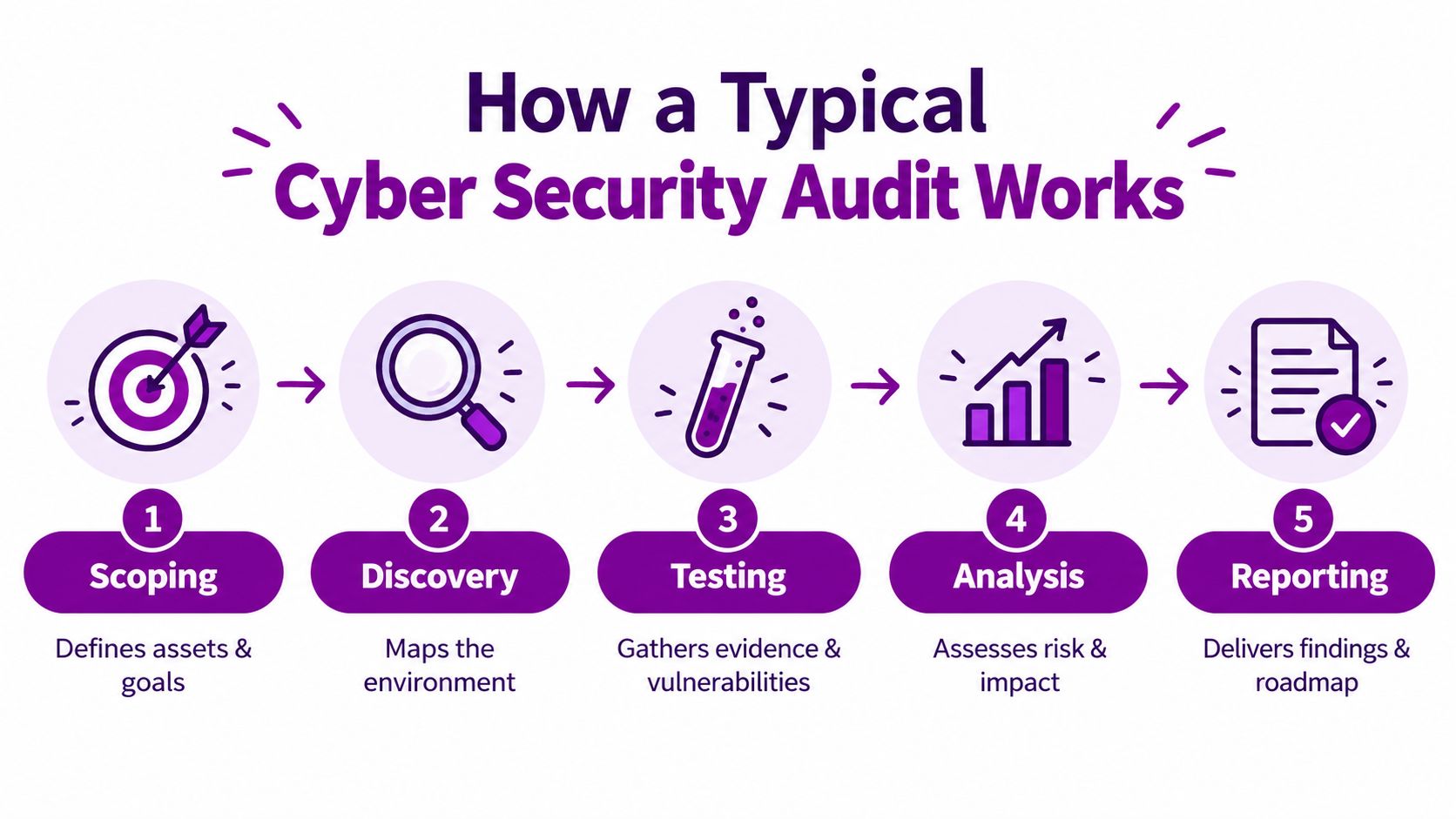
Scoping
The first stage defines objectives, systems, locations, cloud platforms, suppliers and exclusions. For a Microsoft 365 and Azure estate, scope should cover identity, privileged access, devices, applications, data flows, logging and administrative pathways. A vague scope creates a vague conclusion.
Discovery
The auditor maps the environment and gathers evidence. You may be asked for policies, user and administrator lists, configuration exports, incident records, backup evidence, supplier information and remediation tickets. Preparing a single evidence owner can reduce delays and prevent conflicting responses.
Testing
Testing combines document review, interviews, technical checks and, where agreed, controlled security testing. Auditors compare claimed controls with what the environment does. If a policy requires multi-factor authentication, the review should verify its coverage, exceptions and enforcement rather than just confirming that the feature exists.
Analysis
Findings should be assessed by business impact, likelihood, exploitability and the importance of affected systems. A minor issue on an isolated test device shouldn't automatically outrank a weakness affecting administrator access to core cloud services.
Reporting and remediation
The final report should include an executive summary, detailed findings, evidence, risk ratings, owners and a prioritised remediation roadmap. It should distinguish urgent corrective action from planned improvement and explain how the auditor reached each conclusion.
Insurance requirements can influence scope and evidence, so leaders may also benefit from a clear guide to what cyber insurance covers. An audit doesn't replace policy wording, but it can help identify the controls and records an insurer may expect you to maintain.
A useful preparation checklist includes:
- Name an owner: Give one person responsibility for coordinating evidence and questions.
- Map critical services: Identify the systems and suppliers the business can't operate without.
- Gather records: Collect access reviews, patch evidence, incidents, backups and security policies.
- Set decision rules: Agree who can approve urgent remediation and how progress will be reported.
Benefits and ROI You Can Expect From Regular Audits
The commercial value of an audit comes from better decisions. Leaders can direct budget towards weaknesses that could disrupt operations, rather than buying additional tools without knowing whether existing controls are effective.
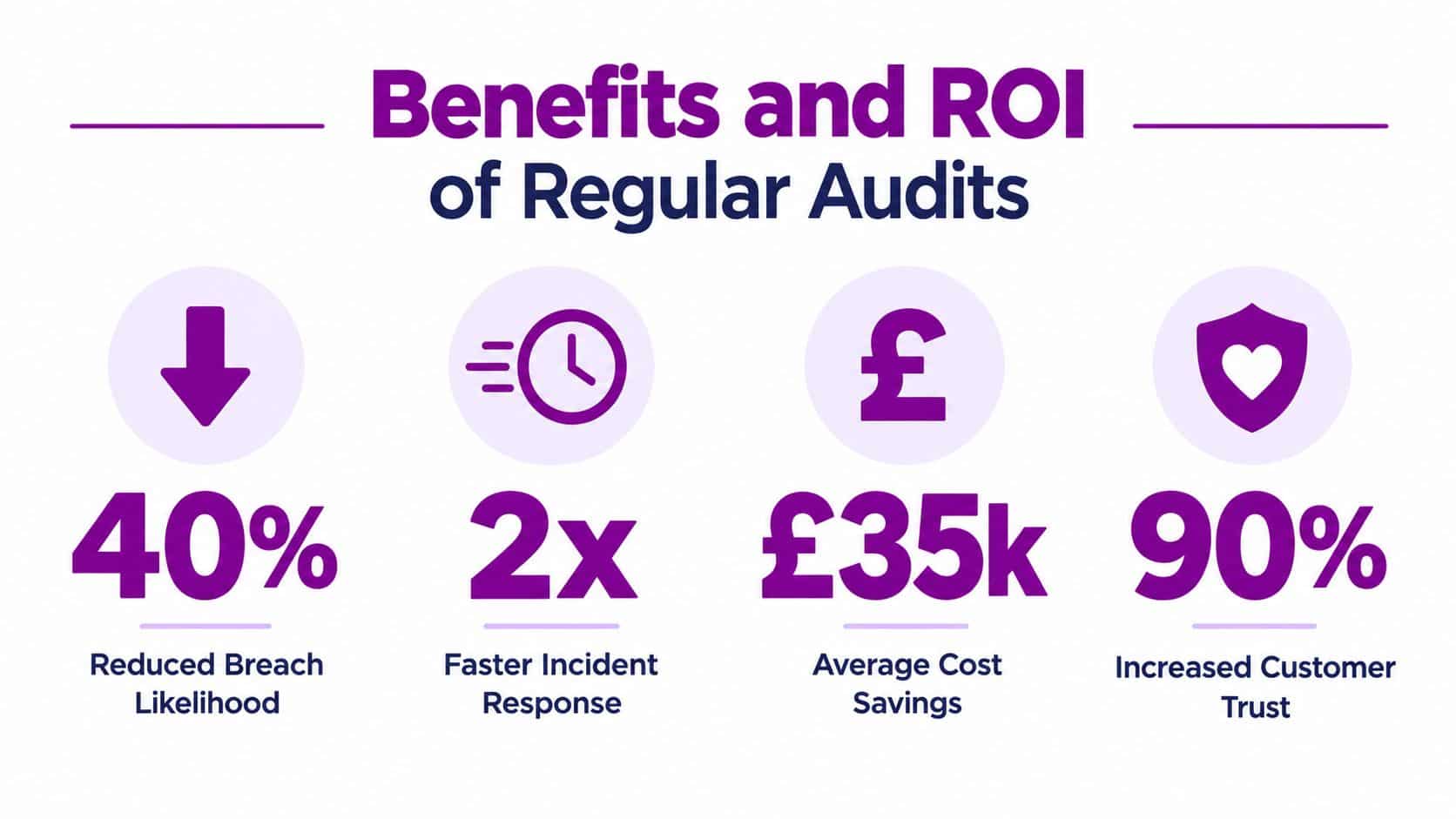
The breach environment makes that discipline practical. The government survey found that phishing was the most common breach type, reported by 38% of businesses, while only a minority of businesses carried out vulnerability audits. That survey evidence points towards a clear priority for many SMEs, strengthen identity, email protection, staff reporting and response processes rather than treating every weakness as equally urgent.
Where the value appears
Fewer repeat weaknesses
A follow-up review checks whether the organisation fixed root causes rather than closing individual tickets. For example, removing one compromised account helps, but improving conditional access, privileged role management and leaver processes addresses the wider failure.
Faster decisions during incidents
An audit can clarify who owns response actions, where logs are held, which supplier should be contacted and how affected accounts are isolated. That preparation reduces hesitation when staff are under pressure.
Stronger commercial confidence
Customers and procurement teams often want evidence that suppliers manage cyber risk responsibly. A current report, certification or remediation plan can make those conversations more straightforward.
Better use of security spend
Risk-ranked findings help leaders compare the cost of remediation with the operational consequences of leaving an issue unresolved. The result is a defensible investment plan, not a collection of disconnected upgrades.
The return isn't the report itself. It comes from turning findings into owned, verified improvements.
Regular reviews also support organisational learning. After an audit, management can track overdue actions, recurring findings, control exceptions and changes in the cloud environment. That turns security from an annual paperwork exercise into a repeatable management process.
Compliance Considerations for UK Businesses in 2026
UK businesses need to distinguish between a general security review and an audit aligned to a recognised assurance framework. Cyber Essentials is the UK Government's minimum recommended cyber security standard, and its certification combines self-assessment with independent audit. Certification pricing starts at £320 plus VAT, according to the NCSC Cyber Essentials information. Cyber Essentials Plus adds more rigorous independent technical testing.
Cyber Essentials Plus provides a practical benchmark because it requires third-party verification. Government data records 61,430 Cyber Essentials certificates awarded from July 2025 to June 2026, including 15,185 Cyber Essentials Plus certifications, as reported in the Cyber Essentials impact evaluation.
The 2026 cloud and identity baseline
The April 2026 Cyber Essentials requirements make multi-factor authentication mandatory where a cloud service supports it, prevent organisations from scoping cloud services out and retain a 14-day fix window for critical and high-risk issues. Microsoft 365 and Azure audits therefore need to examine identity protection, authentication coverage, privileged access, cloud scope, device management and remediation records. A review focused only on office firewalls won't reflect the way many businesses now operate.
The five mandatory Cyber Essentials control areas are:
- Secure configuration: Systems use hardened, approved settings.
- Boundary firewalls: Network boundaries restrict unwanted traffic.
- Access control: Users receive appropriate access and authentication protection.
- Malware protection: Devices and systems defend against malicious software.
- Patch management: Security updates are applied within required timescales.
The NCSC Cyber Resilience Audit scheme provides another route for independent assurance. The scheme was created to give consumers confidence that providers meet the NCSC standard for delivering independent cyber audits. The NCSC reported 17 assured providers for CAF-based audits in 2025, as recorded in its Annual Review 2025.
The Cyber Assessment Framework, or CAF, is designed to assess how well cyber risks to essential functions are managed. It uses objectives, principles, contributing outcomes and indicators of good practice, allowing auditors to test control effectiveness rather than merely confirm that policies exist. The NCSC Cyber Assessment Framework and the UK CAF guidance explain how the framework supports internal assessment and external oversight.
For organisations handling personal information, audit evidence should sit alongside privacy governance. A practical GDPR compliance checklist can help connect access, retention, incident and supplier controls.
How to Choose a Provider and How F1Group Supports You
Provider selection should start with independence and method. Ask how the auditor defines scope, what recognised framework it uses, how Microsoft 365 and Azure settings are tested, how findings are risk-rated and whether remediation is checked after the report.
Look for:
- Clear boundaries: The proposal should name systems, suppliers, cloud services and exclusions.
- Relevant expertise: Auditors should understand identity, conditional access, privileged roles, endpoints, logging and cloud administration.
- Actionable reporting: Findings should include impact, evidence, owners and practical corrective actions.
- Follow-through: Ask whether the provider can help organise remediation and validate closure.
- Local support: East Midlands organisations may value a partner able to work with teams across Lincoln, Nottingham, Leicester, Scunthorpe, Grimsby and Newark.
F1Group has supported organisations across these areas since 1995 and provides Microsoft-focused IT and cyber security support. Its vendor-certified, DBS-checked consultants can review identity, patching and logging across Microsoft 365, Azure and Dynamics 365 environments, then support remediation. Its cyber security consultancy services provide further detail on that broader support.
Choose an audit that answers your actual business question. For one organisation, that may be Cyber Essentials Plus readiness. For another, it may be an Azure identity review, a supplier-access assessment or a CAF-aligned independent audit. The important point is to make the scope explicit and ensure every significant finding has an owner and a next action.
F1Group can assess your Microsoft 365, Azure and wider IT environment, identify identity and configuration gaps, and help organise remediation against the 2026 UK Cyber Essentials baseline. Phone 0845 855 0000 today or Send us a message to discuss cyber security audit services for your organisation, and visit F1Group to learn more.