
On a busy Monday morning, the sales team can’t access a shared folder in Microsoft 365. A director receives an email that looks as if it came from a supplier, asking for an urgent payment change. Someone clicks before anyone has time to double-check. By mid-morning, mail rules have been altered, a login session is still active somewhere it shouldn’t be, and people are asking the same question: is this an IT problem, or a business problem?
It’s a business problem.
For many small and mid-sized organisations, cyber security in business now sits alongside cash flow, staffing, supplier reliability and compliance. It affects whether your team can work, whether customers can trust you, and whether leadership can keep operations moving when something goes wrong. That’s especially true for firms that rely on Microsoft 365, cloud storage, laptops, mobile devices and external IT or software partners to get through the day.
Introduction Why Cyber Security Is Now a Business Issue
The UK figures make the point plainly. The UK Government’s Cyber Security Breaches Survey 2025/2026 found that 43% of UK businesses and 28% of charities experienced at least one cyber security breach or attack in the previous 12 months, which was extrapolated to about 612,000 businesses and 57,000 charities nationwide. The same survey found that phishing remained the most common attack type, affecting 38% of businesses, and that exposure rose with size, with 65% of medium businesses and 69% of large businesses reporting incidents, compared with 42% of micro businesses and 46% of small businesses (UK cyber security survey summary).
That’s why boards and senior managers need to treat cyber risk as part of normal business oversight, not as a side topic for the IT team. If your organisation depends on email approvals, shared files, Teams chats, cloud applications and managed endpoints, an attack can interrupt trading just as surely as a power cut or a failed supplier. This is the same point many leadership teams are now facing in their wider governance discussions, including the role of oversight described in the role of the board.
What this looks like in a real working day
A typical incident doesn’t begin with dramatic hacking screens. It often starts with something ordinary:
- A copied login page catches out a member of staff who’s rushing between meetings.
- An email compromise lets an attacker sit in a mailbox, reading conversations.
- A supplier invoice change arrives at the right moment and looks believable.
- A synced file library spreads the impact quickly across users and devices.
Good cyber security in business isn’t just about stopping every attack. It’s about keeping the organisation working when one gets through.
For East Midlands firms, that practical mindset matters. Many businesses in Lincoln, Nottingham, Leicester, Scunthorpe, Grimsby and Newark don’t need more noise or more jargon. They need a sensible way to decide what matters most, what to fix first, how to question suppliers properly and how to recover without panic.
Understanding How Cyber Security Protects Your Business
Cyber security can sound abstract until you tie it to daily work. The simplest way to understand it is to think about your premises.
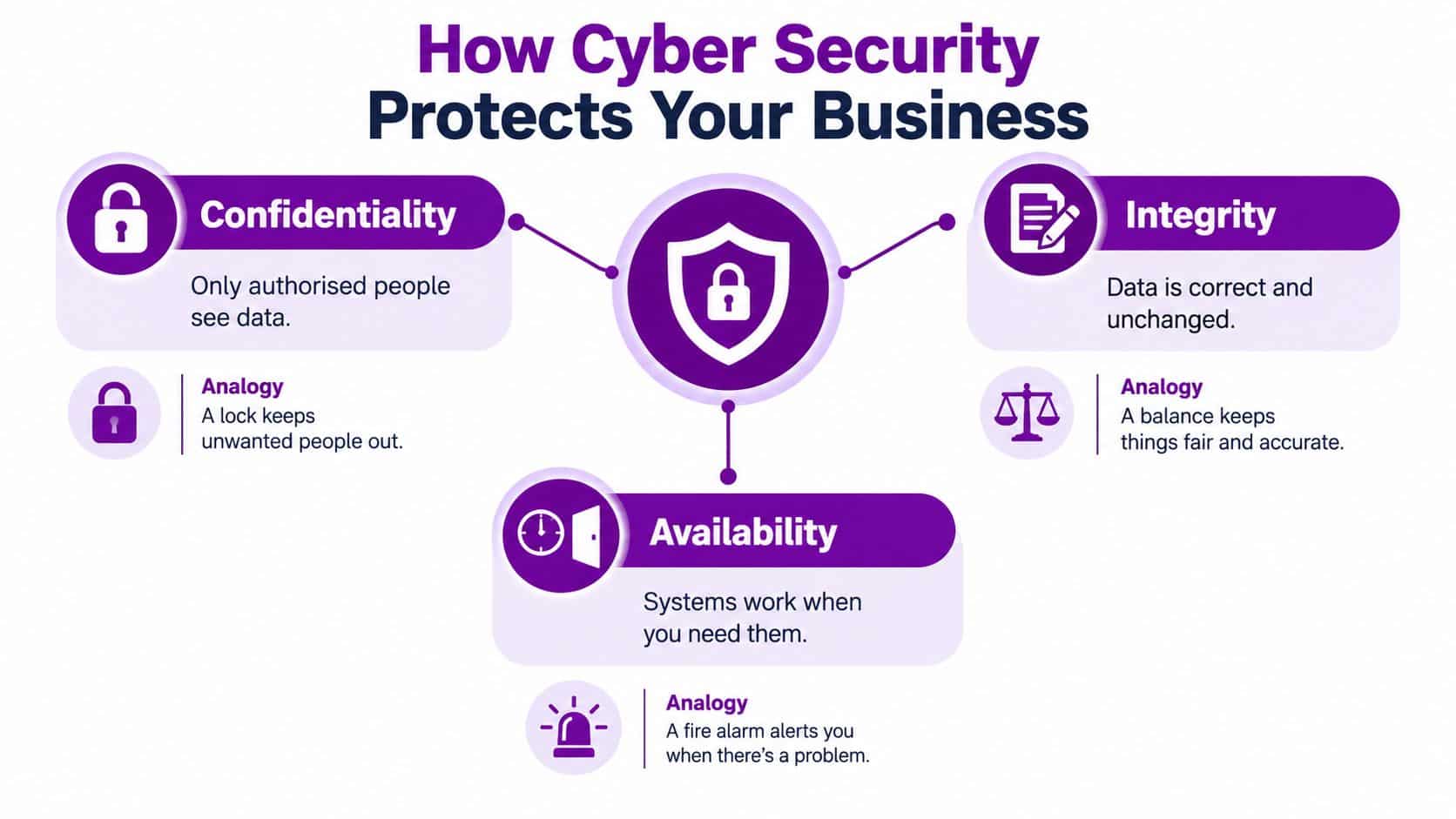
A lock on the front door stops the wrong person walking in. An alarm tells you when something unusual happens. A fire drill doesn’t prevent a fire, but it helps people respond properly. Digital security works in much the same way.
The three things you are really protecting
Most business security decisions come back to three simple ideas.
| Principle | Plain English meaning | Everyday Microsoft example |
|---|---|---|
| Confidentiality | Only the right people can see information | A finance file in SharePoint is limited to authorised staff |
| Integrity | Information stays correct and unaltered | A purchase order isn’t quietly edited by the wrong person |
| Availability | Systems and data are there when needed | Staff can access Outlook, Teams and files during the working day |
These ideas matter because businesses often focus only on secrecy. In practice, availability can hurt just as much. If your staff can't get into Microsoft 365, can't retrieve documents, or can't trust what they see in a mailbox, work stops.
Why identity is now the front door
Many SMEs still picture cyber security as a fence around an office network. That made more sense when most systems sat on a server in one building. It doesn't fit modern working.
With Microsoft 365 and Azure, your users sign in from laptops, phones, home networks and shared spaces. That means identity has become the new perimeter. If an attacker steals or tricks their way into a user's account, they've stepped through the front door without touching your office firewall.
Key concept: In cloud services, a secure platform doesn't automatically mean a secure customer setup.
That's where people often get confused about shared responsibility. Microsoft secures the underlying service. Your organisation still needs to manage access, permissions, devices, data handling and recovery.
That shared-responsibility point also connects with the physical world. If you want a useful read on how digital security intersects with premises, access control and operational safeguards, GM GROUP Services physical cyber gives a practical view of why cyber and physical protection shouldn't be treated as separate conversations.
Layered protection beats one big product
A lot of firms look for a single product to solve everything. That rarely works.
Layered security is more realistic:
- Identity controls help stop account misuse.
- Device protection helps catch malicious activity on laptops and mobiles.
- Access policies limit what a compromised account can reach.
- Backups and recovery processes reduce the damage if prevention fails.
Think of it as a building with locks, visitor checks, cameras and evacuation procedures. No one control is enough on its own. Together, they give you a much better chance of staying operational.
The Most Common Cyber Threats Facing SMEs Today
SMEs are attractive because attackers don't always need a large payoff from one victim. They often want a quick route in, a payment diversion, a stolen mailbox, or disruption they can monetise. For a Microsoft 365-reliant business, the starting point is often surprisingly mundane.
The scale of the problem is not small. UK businesses experienced approximately 5.19 million cyber crimes of all types in the last 12 months, according to the 2025/2026 Cyber Security Breaches Survey sectoral analysis (UK sectoral analysis report). For East Midlands firms, that makes cyber risk a high-frequency operational condition, not a rare edge case.
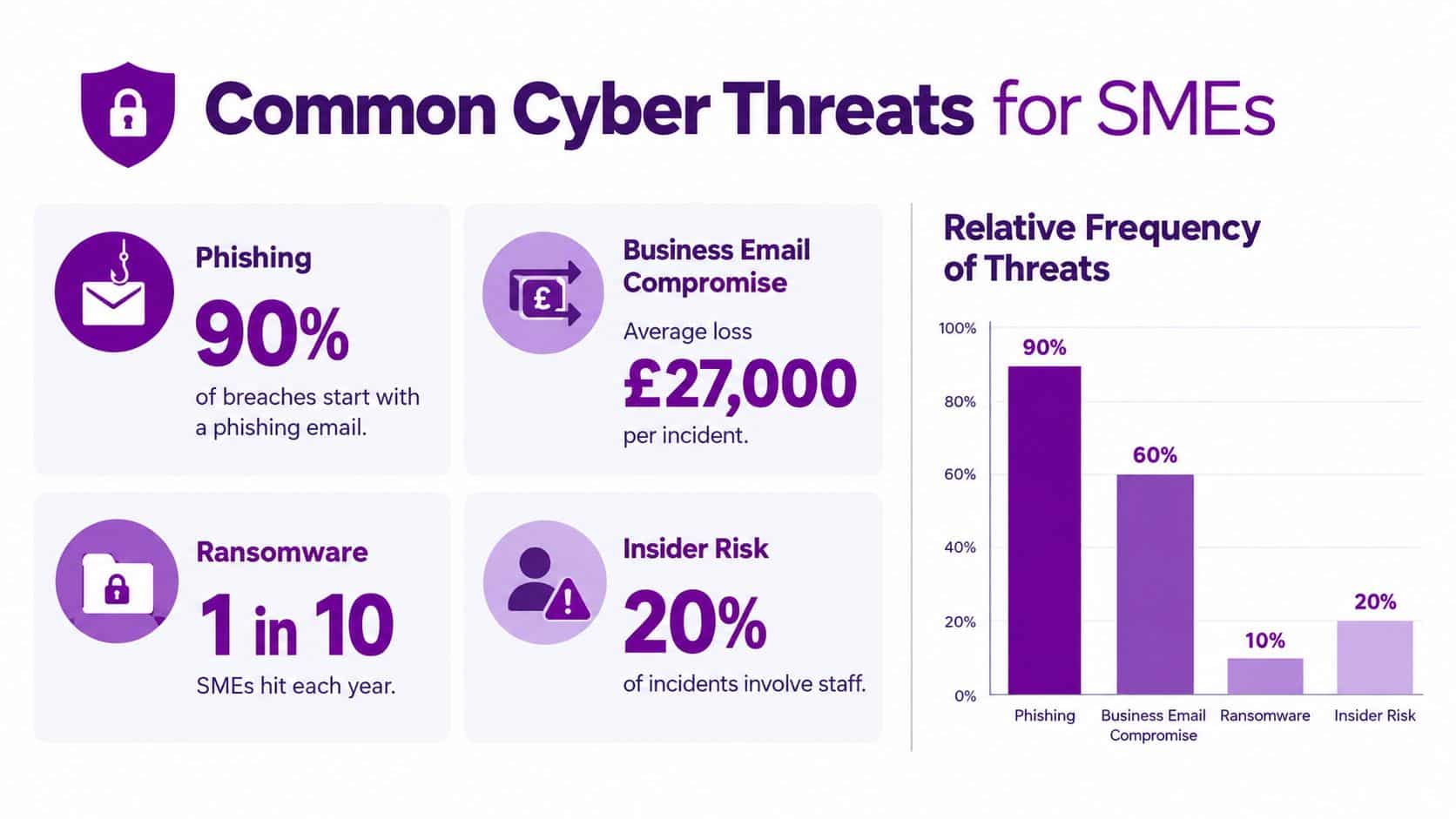
The attacks directors and managers see most often
The first category is phishing. A message asks someone to reset a password, open a document, review a payment or sign into a familiar service. It succeeds because it feels routine.
The second is business email compromise. Here, the attacker doesn't always need malware. They gain access to a mailbox, watch traffic, learn who approves what, then step into the conversation at the moment money or sensitive data moves.
A third is ransomware or wider malware activity. That might start with an email, a malicious download or a compromised account on an unmanaged device. Once inside, the attacker tries to spread, disrupt and make recovery harder.
Then there are insider and accidental risks. Most businesses don't need a malicious employee to suffer damage. One wrong share setting, one forwarded document, or one reused password can create the opening.
To make those patterns easier to spot, this short explainer is worth watching:
Opportunistic attacks and targeted attacks
Not every incident is a carefully researched attack. Many are opportunistic. Attackers cast a wide net and use automation, fake login pages and reused techniques to find someone who clicks.
Others are more targeted. A criminal might study your supplier relationships, copy a senior manager's writing style or exploit timing around payroll, invoice runs or holiday cover. In SMEs, a lean team can make this easier because one person often handles several approvals.
A cyber incident doesn't have to be sophisticated to be costly. It only has to interrupt a process your business depends on.
Why supplier exposure matters more than many firms realise
If your company uses external IT support, cloud applications, payroll systems, file-sharing tools or outsourced finance functions, your risk surface expands. A weakness at a supplier can become your problem quickly.
That's one reason many firms look for outside operational support rather than trying to handle everything alone. For a general view of how ongoing support can help businesses stay ahead of common threats, this article on professional managed IT from We Fix PC is a useful companion read.
How to Assess Your Cyber Risk Without a Large Security Team
A useful risk assessment doesn't need a large security department or expensive software. It needs honesty, consistency and a short list of business priorities.
Start with the question directors care about most: what would stop us operating? That shifts the exercise away from technical inventory alone and towards business impact.
A lightweight method that works
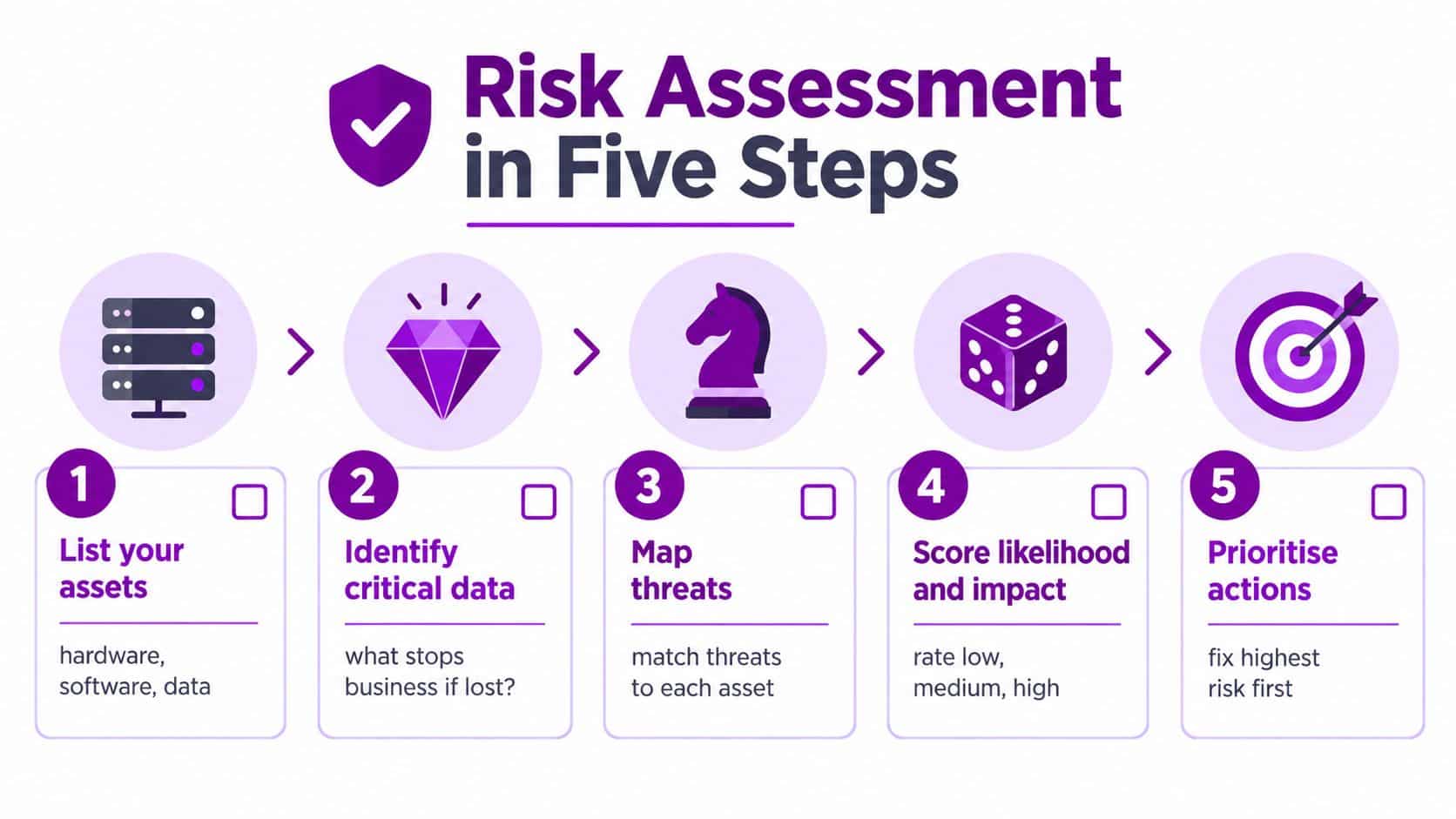
Use a five-step pass through the organisation.
-
List the assets
Include Microsoft 365 tenants, Azure services, laptops, mobile devices, finance systems, CRM platforms, backups and key supplier portals. -
Mark the critical items
Ask which systems would halt trading, delay billing, interrupt customer service or affect compliance if they failed. -
Match likely threats
A finance mailbox may face phishing and payment fraud. A laptop may face malware or theft. A supplier portal may expose shared access risk. -
Score likelihood and impact
Keep it simple with low, medium and high. You don't need false precision to make sound decisions. -
Set an action order
Deal with high-impact, high-likelihood risks first.
Where many assessments go wrong
Many SMEs spend most of their time looking inward and barely assess third parties. That's a gap.
One UK government-linked summary reports that only 15% of businesses formally review the cyber risks posed by their immediate suppliers, while just 25% have a formal incident response plan. The same summary notes that DSIT announced £90 million of new funding in May 2026 to strengthen cyber security across the UK, with a focus on SMEs and priority sectors (UK SME cyber security 2026 summary).
That combination is striking. Businesses are buying tools, but governance and recovery often lag behind.
Practical rule: If a supplier can access your data, your systems, or your users, they belong on your risk register.
A simple supplier review can ask:
- What access do they hold to your Microsoft 365, Azure or line-of-business systems?
- How do they authenticate when accessing your environment?
- What happens if they're breached and need to notify you quickly?
- How would you continue working if their service became unavailable?
If you'd like a more structured version of that process, a formal security risk assessment can help turn a rough discussion into a documented set of priorities.
Essential Controls That Strengthen Everyday Resilience
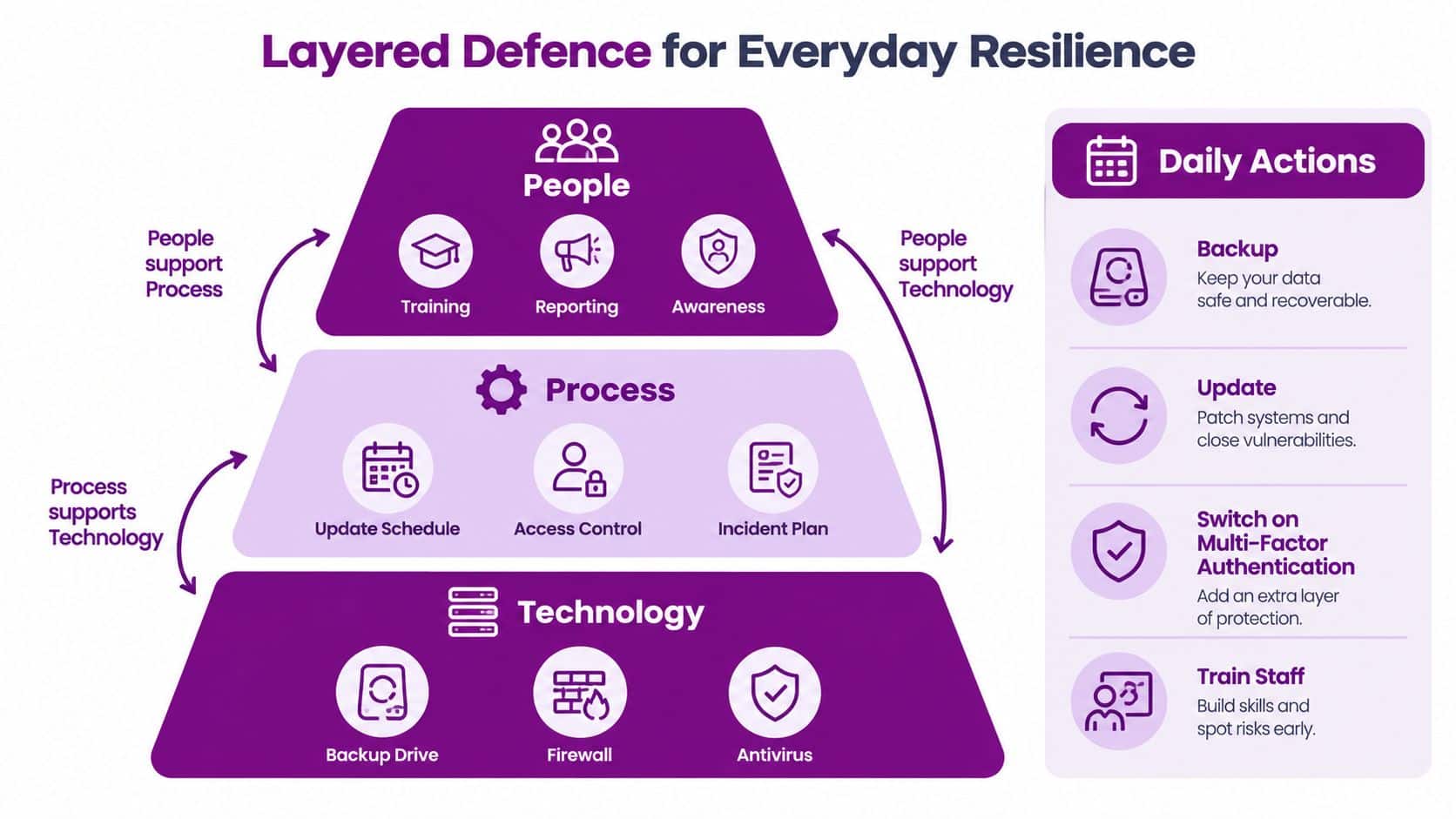
Security controls work best when they support normal business habits instead of fighting them. A strong setup for cyber security in business combines people, process and technology. If one of those is missing, the others carry too much weight.
Start with the basics and do them properly
The National Cyber Security Centre's small business guidance is built around five actions: back up data, protect against malware, keep smartphones and tablets safe, use passwords to protect data, and avoid phishing attacks. The NCSC says these steps significantly improve cyber resilience for small organisations (annual cyber security sectoral analysis coverage).
Those basics still matter because they reduce the damage from ordinary mistakes and ordinary attacks.
- Backups: Make sure critical data can be restored, not just copied somewhere.
- Malware protection: Keep endpoint protection active and centrally managed.
- Mobile safety: Treat phones and tablets as business devices, not side items.
- Passwords and access: Reduce weak, shared or unmanaged credentials.
- Phishing awareness: Give staff a simple route to query suspicious messages quickly.
Build the controls around Microsoft 365 and Azure reality
For cloud-first SMEs, the next layer should fit how work happens.
A practical stack often includes phishing-resistant multi-factor authentication, endpoint detection and response, patching, monitoring, and immutable backup design where possible. The point isn't to buy everything at once. The point is to reduce the easiest paths attackers use.
For example, a mailbox compromise in Microsoft 365 becomes less damaging when sign-ins are better protected, suspicious behaviour is monitored, endpoints are managed, and recovery steps are rehearsed. A laptop infection becomes less disruptive when the device is monitored, the user has limited access, and key data is recoverable.
The UK cyber security sector generated an estimated £14.7 billion in revenue in the latest financial year and employs about 69,600 FTEs, showing there is a mature domestic supplier base for managed security, threat detection and incident response (UK cyber security sector and breaches publication). That matters because SMEs don't have to solve everything in-house. They can benchmark what they need against real capability in the market.
Choosing Controls by Business Risk and Effort
| Control Area | Business Risk It Reduces | Effort and Cost Indication |
|---|---|---|
| MFA with stronger sign-in methods | Stolen password misuse and account takeover | Moderate effort, usually high value for cost |
| Endpoint detection and response | Malicious activity on laptops and desktops | Moderate to higher effort, ongoing service cost |
| Patch management | Exploitation of known weaknesses | Moderate effort, steady operational discipline |
| Backup and restore testing | Long outages and failed recovery | Moderate effort, essential operational cost |
| Access reviews | Excess permissions and supplier overreach | Low to moderate effort, high governance value |
| Incident plan and exercises | Slow, confused response during an incident | Low cost, high organisational value |
| Staff reporting process | Delayed detection of phishing and fraud | Low effort, depends on training and culture |
| Supplier security review | Third-party compromise and service interruption | Low to moderate effort, often overlooked |
Fewer tools, tighter operations
Some firms keep adding products while leaving process gaps untouched. That's where resilience suffers. A business with clear supplier controls, tested backups, sensible access rights and a rehearsed response plan is often in a stronger position than a business with more licences but less discipline.
That principle also extends beyond software. Sensitive conversations, executive travel, confidential projects and physical meeting spaces can introduce exposure too. In niche cases where organisations suspect covert listening devices or need discreet assurance around confidential environments, specialist services such as residential bug sweep services London show that information security sometimes reaches beyond the network and into the room itself.
For businesses that want outside support on Microsoft-focused environments, managed monitoring and response can sit alongside in-house IT. F1Group provides services in areas such as security operations monitoring, incident response support, vulnerability management and security assessments for organisations using Microsoft 365 and Azure.
Planning for the Worst With Incident Response and Recovery
Sooner or later, a control will fail, a user will click, or a supplier issue will spill into your operations. The difference between a contained incident and a prolonged disruption is often the response, not the original event.
A good incident plan is less like a policy document and more like a fire procedure. People need to know who decides, who investigates, who communicates, and what gets shut down first.
The sequence that keeps incidents under control
Most response activity follows a practical rhythm.
First comes detection. Someone spots suspicious sign-ins, a user reports a message, or monitoring identifies unusual behaviour.
Then comes containment. That might mean disabling an account, isolating a device, stopping forwarding rules or restricting supplier access while facts are checked.
After that comes eradication and recovery. Remove the cause, restore clean access, verify systems and bring services back in a controlled order.
Finally, there's review. If you skip that step, the same weakness often stays in place.
Recovery starts long before an incident. It starts when you test whether your backups, contacts, decisions and escalation paths actually work.
Roles matter more than many teams expect
During an incident, confusion wastes time. Leadership should know who can approve shutdown decisions. IT should know what evidence to preserve and what can be changed immediately. Managers should know how to report issues without starting a rumour mill. Communications staff should know when customers, staff or suppliers need an update.
One UK summary noted earlier found that only a minority of businesses had a formal incident response plan. That gap matters because even a short outage can trigger delayed deliveries, missed invoices, customer concern and internal uncertainty.
A useful playbook usually includes:
- A contact list for leadership, IT, legal, insurers and key suppliers
- An escalation rule for account compromise, ransomware signs and payment fraud
- Restore priorities so critical services return first
- A communications draft for staff and external stakeholders
- A short lessons-learned review after the event
If your organisation hasn't documented that yet, a focused incident response planning exercise can turn assumptions into something the team can use under pressure.
Next Steps to Strengthen Cyber Security in Your Organisation
The most useful next step is usually not buying another tool. It's deciding where your current operational risk really sits.
If your business relies heavily on Microsoft 365, Azure, shared file access and supplier-delivered systems, start by asking four questions:
- Could we spot account misuse quickly enough?
- Could we restore critical data and services cleanly?
- Do we know which suppliers create the biggest exposure?
- Would managers know what to do in the first hour of an incident?
If the answer to any of those is uncertain, that's where attention should go first.
What to handle in-house and what to get help with
In-house teams can often manage day-to-day hygiene well when responsibilities are clear. That includes user onboarding, patching routines, access reviews and straightforward awareness activity.
External support becomes more useful when you need continuous monitoring, deeper Microsoft security configuration, backup resilience, vulnerability review, or structured incident readiness. For organisations across Lincoln, Nottingham, Leicester, Scunthorpe, Grimsby and Newark, that blend often makes more sense than trying to build a full specialist function internally.
A sensible short checklist for this month would be:
- Review privileged accounts in Microsoft 365 and Azure.
- Check backup restoration rather than assuming backups are fine.
- List core suppliers with access to systems or data.
- Turn supplier questions into a repeatable review.
- Write a first-draft incident playbook for leadership and IT.
- Decide which gaps need managed support rather than ad hoc effort.
Phone 0845 855 0000 today or Send us a message if you want to discuss how to prioritise those steps in a practical way.
If your organisation needs help tightening Microsoft 365 security, reviewing supplier exposure, improving backup resilience or preparing for incident response, F1Group offers hands-on support for East Midlands businesses using Microsoft-focused systems. Phone 0845 855 0000 today or send us a message to talk through the risks that matter most and the controls that will make the biggest difference.