
You're probably here because someone has just asked for Cyber Essentials certification and you don't want a lecture. You want to know whether it matters, what it will cost, how painful it will be, and what could trip you up.
That's the right way to look at it.
Most UK business owners don't go looking for Cyber Essentials out of curiosity. A tender lands in your inbox. A client procurement team asks for it. Your insurer starts asking harder questions. Or your IT team says, “We should get this sorted before it becomes urgent.” By that point, you need a practical answer, not vague cyber jargon.
The short version is simple. Cyber Essentials is no longer a nice extra for many organisations. It's becoming a baseline business requirement. In 2026, the bigger mistake isn't failing the questionnaire. It's treating certification like a one-off annual task when the scheme now expects ongoing compliance from senior leadership.
What Is Cyber Essentials and Why Is It Suddenly Everywhere
A familiar scenario. You've spent weeks preparing a proposal for a public sector contract, or a larger customer is reviewing suppliers. Then procurement sends over a checklist, and one line changes the whole conversation: “Please provide your current Cyber Essentials certificate.”
If you haven't got it, you're on the back foot immediately.

A government-backed baseline, not a luxury add-on
Cyber Essentials was launched by the UK government in 2014 and is overseen by the National Cyber Security Centre. It's the minimum recommended baseline standard for organisations of all sizes to protect against common internet-based cyber threats, and the controls collectively block approximately 80% of common cyber security threats according to the Cyber Essentials overview.
That matters because most attacks against smaller firms aren't Hollywood-style incidents. They're routine. Weak passwords, unpatched devices, over-privileged accounts, poorly configured laptops, and malware getting through because the basics weren't enforced.
Why business owners keep hearing about it
Cyber Essentials keeps appearing because it solves three real business problems:
- Contract access: Some public sector opportunities require it.
- Supplier assurance: Larger firms and banks increasingly want proof that their suppliers meet a basic cyber standard.
- Operational discipline: It forces you to fix the obvious weaknesses many businesses ignore for too long.
Practical rule: If a customer handles sensitive data and asks about your security posture, assume Cyber Essentials may come up sooner rather than later.
It also gives non-technical directors something useful: a recognised framework with a clear scope. That's valuable when you need to show customers, insurers, trustees, or a board that your business has done more than install antivirus and hope for the best.
Cyber Essentials isn't a full information security management system. It's narrower than that. But for many small and mid-sized UK businesses, that's exactly why it works. It sets a reasonable baseline and makes you prove you're applying it.
The Five Core Technical Controls Your Business Must Implement
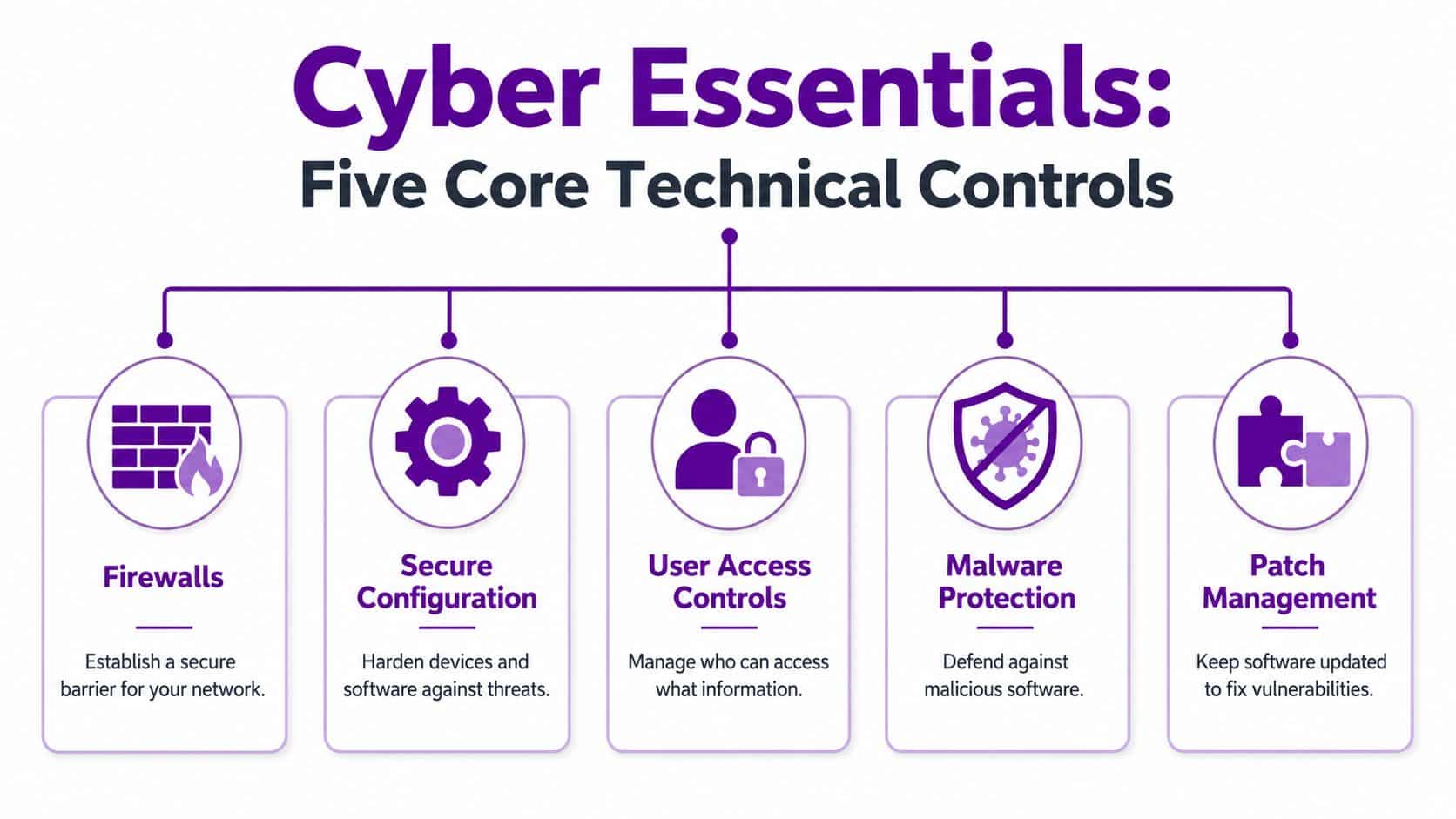
Cyber Essentials stands on five mandatory technical controls. If your business can't meet them in practice, you won't get through certification cleanly. None of them are exotic. They're basic, sensible, and often neglected.
Firewalls and secure configuration
Firewalls are your first control point. In plain English, that means your internet connection and devices need a sensible barrier between your business systems and the outside world. If your router is still using default settings, or if you've allowed unnecessary services through, you're making life easy for attackers.
Secure configuration means stripping out the bad habits that creep into day-to-day IT. Don't leave default passwords in place. Don't let users run with bloated admin rights. Don't keep unused software installed. Don't deploy laptops with weak settings because “we'll fix it later”.
Examples of what this looks like in real life:
- Router setup: Change default credentials and disable features you don't need.
- Laptop builds: Remove unnecessary local admin rights and enforce screen locks.
- Microsoft 365 devices: Make sure standard security settings are applied, not just discussed.
A written standard helps here. If you're tightening internal rules, an IT security policy template is a useful starting point.
User access controls and malware protection
User access control is about giving people access to what they need, and no more. That sounds obvious, but many businesses still have shared accounts, ex-staff accounts left active, and users with administrative access because it's convenient.
That convenience becomes expensive when an account is compromised.
Malware protection isn't just “buy antivirus”. It means making sure your endpoints are protected, your policies are enforced, and risky behaviour is controlled. If staff can download anything from anywhere and run it with administrative privileges, your protection is weak no matter what product badge you've bought.
Good cyber hygiene usually fails for one reason. Nobody owns it day to day.
Patch management is where many firms fail
The strictest point is often security update management. Cyber Essentials requires high-risk or critical software vulnerability fixes to be applied within 14 days of release for all in-scope devices, and failure to meet that window results in immediate disqualification according to the NCSC requirements.
That's the part many businesses underestimate. It isn't enough to say your team “usually patches monthly”. If a critical update sits uninstalled beyond that deadline, you've got a problem.
A quick sense check for your environment:
- Check supported software: Unsupported operating systems and end-of-life apps are red flags.
- Review device management: Laptops outside your patching system will catch you out.
- Look at remote staff: Home-based devices still count if they're in scope.
- Test your evidence: If asked, could your team show patch status confidently?
For a plain-English overview of the controls, this short explainer is worth a look before you start internal prep.
Why Cyber Essentials Matters More Than Ever for UK Businesses
A director signs off the annual Cyber Essentials questionnaire in March. By June, a remote laptop misses a critical patch, a member of staff keeps local admin rights they should not have, and procurement asks for proof your controls still hold. The certificate is still on the wall. Your actual exposure has already changed.
That gap is why Cyber Essentials carries more weight in 2026. The scheme is no longer something sensible businesses can treat as a once-a-year admin task. Ongoing compliance changes the job. Directors need evidence that controls are being maintained between renewal dates, not assumed.
It affects sales faster than most firms expect
Cyber Essentials now sits in the path of revenue. Public sector work can require it. Larger customers use it to filter suppliers before serious commercial discussions begin. If your business wants to win contracts with regulated clients, funded projects, or larger supply chains, certification stops being optional in practical terms.
It also cuts procurement drag. Security questionnaires move faster when you can point to a recognised baseline instead of writing bespoke answers every time. That saves management time and reduces the risk of a deal stalling because nobody can explain how devices, accounts, and updates are being controlled today.
It exposes a board-level risk that many firms still miss
The main problem is not failing the assessment once. The main problem is passing, then drifting out of compliance while management assumes everything is fine until the next renewal.
That is a governance failure.
The reason this is significant is that common attacks usually exploit routine gaps, overdue patching, weak account control, exposed internet services, and poor device configuration. A valid certificate does not protect you if the underlying controls slip three months later. Directors who treat Cyber Essentials as a yearly event are managing paperwork, not risk.
If you need a broader benchmark for ongoing security governance, F1Group's guide to the Cyber Assessment Framework for UK organisations is a useful reference point.
It can help with insurance and incident costs
Certification can also support a better insurance position, particularly for smaller UK businesses, because it shows you have put basic controls in place and had them checked. A key benefit is that it lowers the chance of a simple preventable issue turning into a claim, a client dispute, or an expensive clean-up exercise.
Here is the practical business case:
| Business issue | Why Cyber Essentials helps |
|---|---|
| Tender requirements | Gives buyers a recognised security baseline |
| Insurance scrutiny | Shows your business has defined controls in place |
| Supplier due diligence | Reduces back-and-forth over basic security evidence |
| Director oversight | Forces regular review of specific, testable controls |
| Operational drift | Highlights the need for ongoing checks between renewals |
It brings everyday tools under proper control
Many incidents start with ordinary business software, not complex attacks. Forms, file sharing, email access, collaboration apps, and remote devices all create risk when nobody owns the rules around them. If your team collects client or staff information through online forms, review the practical risks around data safety on Google Forms. It is a good example of a wider truth. Familiar tools still need oversight.
Customers will not care whether a breach came from a missed update, a bad admin setting, or a careless form setup. They will care that your business failed to keep control after claiming it had the basics covered.
Cyber Essentials vs Cyber Essentials Plus What Is the Difference
Directors usually frame this decision badly. They focus on the cheaper badge, then act surprised when a client, insurer, or procurement team asks for stronger evidence six months later. In 2026, that mindset is risky. Ongoing compliance means you need to prove controls still work after certification, not just on the day you answered a questionnaire.
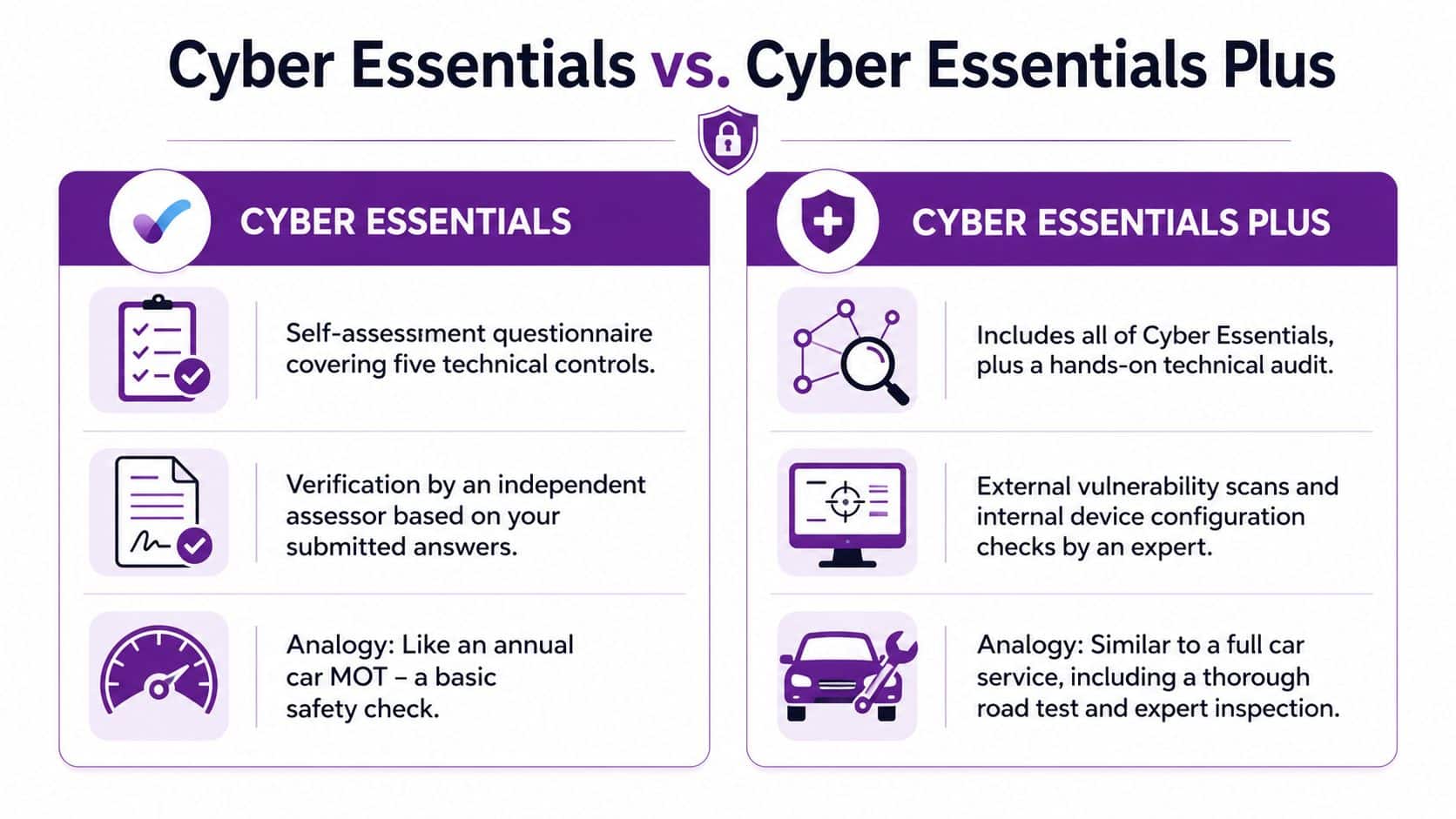
Both certifications are built on the same five technical controls. The difference is the level of checking, and how much confidence that gives your customers and board.
One is attestation. The other is testing.
Cyber Essentials is a verified self-assessment. Your business completes the questionnaire, states how the controls are applied, and an assessor reviews those answers.
Cyber Essentials Plus adds independent technical verification. Your devices, user setup, and security controls are tested to confirm the actual position matches what the business claims.
That distinction matters.
A self-assessment can confirm policy and intent. Plus is far better at exposing weak enforcement, patching gaps, stray admin rights, and devices that sit outside the process. That is why I recommend Plus for firms with remote staff, cloud-heavy environments, or directors who want evidence rather than reassurance.
Side-by-side differences
| Area | Cyber Essentials | Cyber Essentials Plus |
|---|---|---|
| Assessment method | Verified self-assessment | Independent technical testing |
| Technical basis | Same five controls | Same five controls |
| Assurance level | Baseline assurance | Higher assurance |
| Typical use | Entry-level requirement | Stronger client or contract expectation |
Standard Cyber Essentials can be enough if you need to meet a basic supplier requirement and your environment is simple.
Cyber Essentials Plus is the better choice if you handle sensitive client data, support regulated customers, bid for higher-trust contracts, or want to catch operational drift before it becomes a failed renewal or a security incident. That last point matters more in 2026. Annual certification alone does not protect you if controls slip between assessments.
There is also a governance angle. Directors who treat Cyber Essentials as a once-a-year admin task miss the actual exposure. A certificate does not fix poor joiner-mover-leaver processes, unmanaged laptops, or local admin sprawl. Continuous review does. Businesses already aligning security with wider standards often see the same pattern when mastering ISO 27001 compliance. Evidence has to match day-to-day practice.
If you want a more detailed comparison of testing, scope, and preparation, this guide to Cyber Essentials Plus certification explains what the higher-assurance route involves.
Your Step-by-Step Guide to Getting Certified
A director signs off the renewal budget in good faith. Two weeks later, the IT team discovers old laptops are still unpatched, a few staff still have local admin rights, and nobody is certain which cloud services sit in scope. That is how Cyber Essentials projects slip, and in 2026 the bigger risk is not the application itself. It is treating certification as a yearly form instead of an ongoing control check.
Start by finding out what would fail today
Set the scope first. Be precise. List the users, devices, servers, cloud platforms, and network equipment that support the part of the business being assessed. If you cannot name what is in scope, you are not ready to answer the questionnaire accurately.
Then run a blunt readiness check against daily reality, not policy documents. Look for unsupported operating systems, missing patches, unmanaged home or remote devices, shared accounts, weak access control, and exceptions that have become normal. Directors should pay attention here because these are the issues that turn a tidy annual renewal into a rushed remediation project.
Follow the process in the right order
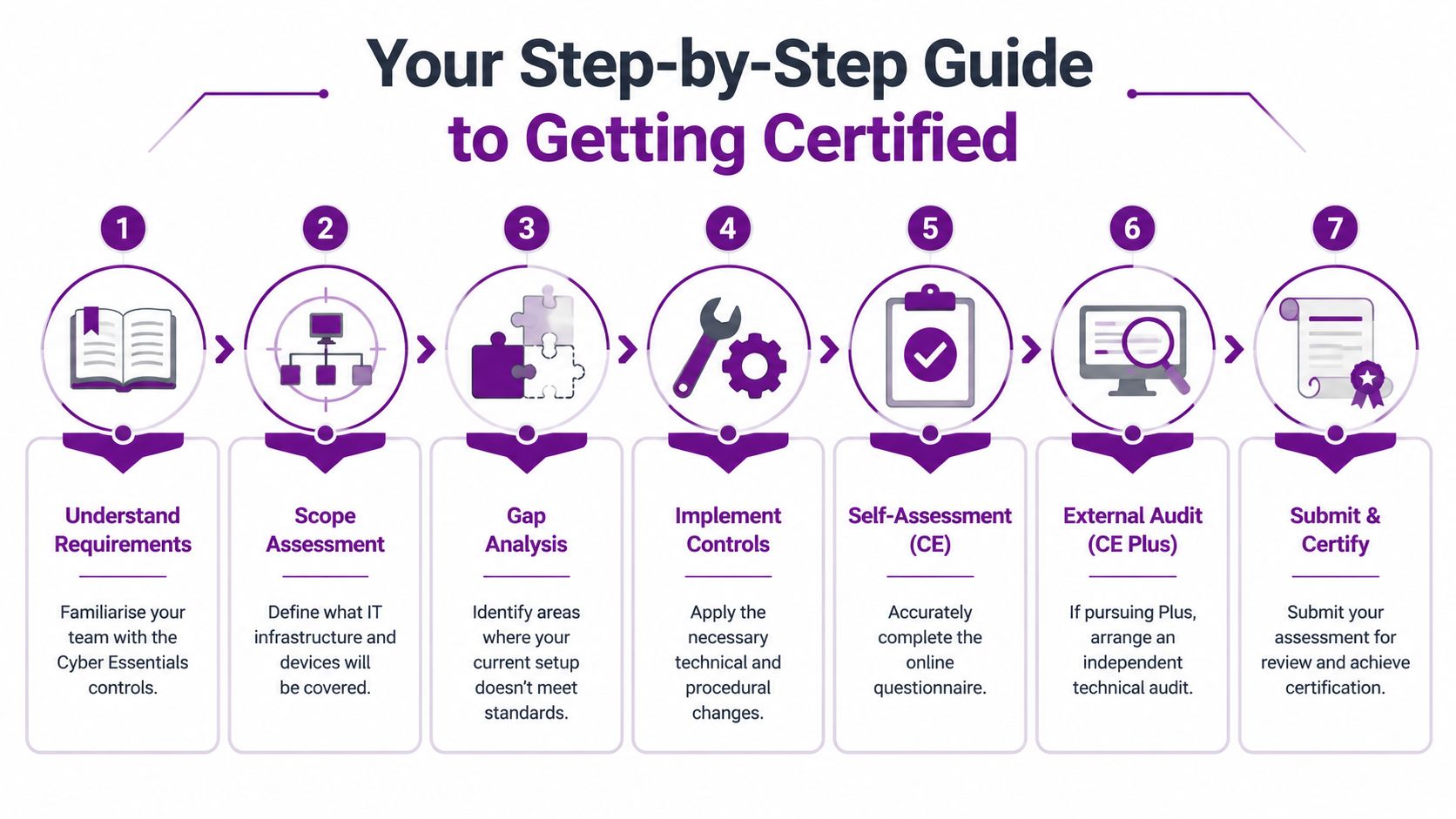
Use this sequence:
- Define the assessment scope: Confirm exactly which people, assets, and services are covered.
- Run a gap review against the five controls: Identify where your current setup falls short.
- Fix the obvious failures first: Patch systems, remove unnecessary admin rights, secure device settings, and clean up user access.
- Collect evidence as you go: Keep screenshots, system records, and configuration details while changes are being made.
- Choose an accredited certification body: Do not leave assessor selection to the last minute.
- Complete the self-assessment carefully: Bad answers create delays and unnecessary back-and-forth.
- Plan renewal and ongoing checks now: The control standard does not pause after you get the certificate.
One point matters more in 2026 than it did a few years ago. Ongoing compliance needs an owner. If patching, access reviews, device management, and policy exceptions drift after certification, your business carries the risk even while the certificate is still on file.
Treat certification as an operating routine
Well-prepared businesses usually get through the standard assessment quickly. Cyber Essentials Plus takes longer because independent testing has to be scheduled and passed. Either way, the certificate only reflects the state of your environment at that point in time, and it lasts 12 months.
That is why mature firms build a simple governance cycle around it. Monthly patch checks, joiner-mover-leaver reviews, device inventory updates, and periodic admin-rights reviews stop the annual renewal from becoming a scramble. The same discipline appears in wider governance work. Businesses already focused on mastering ISO 27001 compliance usually understand that evidence has to match day-to-day practice.
For firms that need hands-on support with remediation, assessment prep, and certification activity, F1Group offers consultancy and delivery support as one available route.
Understanding the Costs and Timelines in 2026
The certificate fee is rarely the primary issue. The core issue is whether your business has budgeted for the work needed to become compliant.
The published price is only the starting point
In 2026, Cyber Essentials self-assessment costs start at £320 + VAT for micro-organisations and rise to £600 + VAT for large organisations. Cyber Essentials Plus starts at £1,499 + VAT and rises based on complexity, according to this 2026 Cyber Essentials cost guide.
That fee buys the assessment process. It doesn't automatically fix your estate.
Here's the budgeting reality:
- Staff time: Someone has to gather evidence, review settings, and coordinate responses.
- Remediation spend: You may need better endpoint protection, device management, or system upgrades.
- Old kit replacement: Unsupported hardware and software often become the hidden blocker.
- Third-party support: Some firms need outside help to clean up access controls, patching, or policy issues.
Build a compliance budget, not just a certification budget
A cheap certificate can become an expensive scramble if your environment is untidy. The firms that handle this well usually treat Cyber Essentials like a short improvement project, not a form-filling exercise.
A sensible budgeting view includes:
| Cost area | What to expect |
|---|---|
| Assessment fee | Fixed certification cost based on size and tier |
| Internal labour | Time from IT, operations, and leadership |
| Remediation | Security tools, upgrades, policy changes |
| External assistance | Optional advisory or implementation support |
If you're price-checking options, compare more than the headline fee. Ask how much effort your team will need to invest, what technical cleanup is likely, and whether you're aiming for a quick pass or a stable operating standard.
Get Certified with F1Group Your Readiness Action Plan
The businesses that struggle with Cyber Essentials usually don't fail because the standard is unreasonable. They fail because their day-to-day IT drifted. Old software stayed in place. Admin rights weren't reviewed. Devices missed updates. Routers were never hardened properly. Someone assumed another person was handling it.
That gets more serious in 2026.
Ongoing compliance changes the director's risk
The 2026 update introduces a critical change: senior leaders must sign a declaration of ongoing compliance throughout the certification year, shifting the burden from a one-off audit to continuous governance, as explained in this summary of the 2026 Cyber Essentials update.
That's the part too many directors will miss.
If your business passes in January but falls out of compliance in April, the issue isn't just technical. It becomes a leadership and governance problem. You've effectively told the market you maintain a standard that you no longer maintain.
A practical readiness check
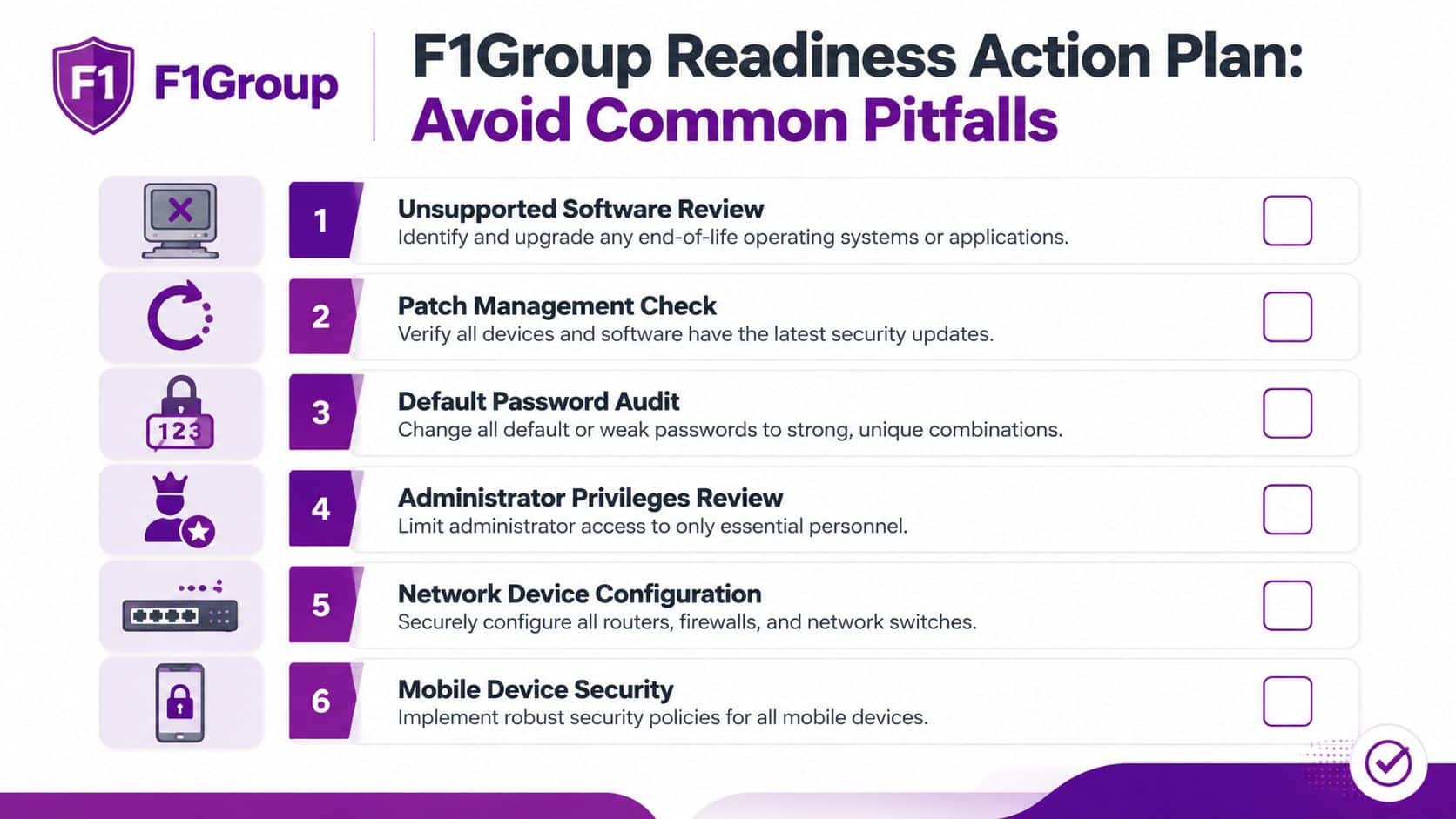
Before you apply, ask these six questions:
- Unsupported software: Are any PCs, servers, or business-critical applications end-of-life?
- Patch discipline: Can you show that important updates are being applied consistently and quickly?
- Password hygiene: Have default or weak passwords been removed across devices and systems?
- Admin access: Do only essential staff hold administrator privileges?
- Network configuration: Are routers, firewalls, and switches configured securely?
- Mobile control: Are phones and tablets used for work properly managed?
Treat Cyber Essentials like a living control set. If your standards only exist on assessment day, you're exposed for the rest of the year.
That's why ongoing governance matters more than the certificate itself. Passing once is useful. Staying compliant is what protects the business.
If you want a practical route to Cyber Essentials certification without wasting time on guesswork, speak to F1Group. We can help you assess readiness, identify the gaps that will stop you passing, and put a workable plan in place for continuous compliance. Phone 0845 855 0000 today or send us a message.