
A production line in Nottingham stops because Microsoft Exchange has failed. The person who normally “looks after IT” is already dealing with a Wi-Fi fault, a laptop replacement and an urgent user access problem. By lunchtime, the business is paying people to wait, while the supplier's support number offers a ticket reference rather than a solution.
That situation is common in East Midlands small and mid-sized businesses. The question for an MD or IT manager isn't whether technology matters. It's whether your current support arrangement gives someone clear responsibility for keeping the business secure, available and recoverable.
A fully managed IT service is a resilience and governance decision, not just a way to outsource helpdesk tickets. The right provider takes ownership of the operating environment, documents what it owns, reports what it finds and gives your business a controlled route through incidents, change and growth.
What a Fully Managed IT Service Actually Means
A fully managed IT service gives an external provider responsibility for agreed technology outcomes. That normally covers Microsoft 365, endpoints, servers, networks, backups, security controls and user support. The boundary must be documented in plain language. The provider should monitor the environment, maintain it and act before a fault becomes a business interruption.
Break-fix support works differently. It responds to reported outages, failed laptops or locked accounts. That approach can suit isolated tasks, but your business still owns monitoring, patching, backup verification and security decisions. Break-fix buys engineer hours. A fully managed service buys ongoing ownership of the environment.
A co-managed arrangement shares that ownership. Your internal IT contact remains responsible for selected systems or decisions, while the external partner manages defined services such as Microsoft 365, cyber security, endpoint management or out-of-hours monitoring. This model suits businesses with capable internal staff that need specialist coverage or additional capacity.
The accountability shift
A fully managed model should be built around an SLA-backed agreement, rather than ad-hoc invoices and informal promises. The agreement needs response targets, escalation routes, supported systems, planned maintenance, reporting requirements and exclusions. Engineers should use approved tools, follow documented procedures and record actions taken.
You still retain control over major technology decisions. The provider should involve you in significant changes, risk acceptance, budgets and business priorities. Routine operational work then has a named owner instead of depending on one overworked employee remembering every task.
Ask four direct questions before signing:
- Which systems and services do you own?
- How do you measure and report performance?
- What happens when an issue falls outside scope?
- Who makes the escalation decision during a serious incident?
Practical rule: If a provider cannot answer those questions clearly, you are considering outsourced labour rather than a fully managed service.
The UK market is large enough to support different delivery models. Government research estimated 11,492 active providers in 2022, generating £52.6 billion in annual managed-services revenue, supporting £29.1 billion in direct GVA and employing 294,340 FTEs. The sector had grown at a 12% compound annual growth rate over the preceding six years. 53% of providers were dedicated IT service firms, while 47% operated across areas such as telecoms, hardware or consultancy, according to the UK government research on managed service providers.
For a practical explanation of what a managed service provider does, compare the model with your current ticket log, asset list and internal responsibilities. In an East Midlands SMB, that comparison should show who owns recovery, security decisions and service continuity when your internal contact is unavailable.
What Is Usually Included Day to Day
A useful way to test a proposal is to follow a normal working day in your business. Staff sign into Microsoft 365, access a line-of-business application, connect to shared data, use laptops and phones, and rely on internet, Wi-Fi and security controls. Each dependency should have an owner.
The operational baseline
A properly scoped service commonly includes:
- Monitoring: Servers, firewalls, switches, wireless devices, cloud platforms and critical services are monitored for faults and unusual behaviour. Monitoring only matters if somebody responds to alerts and records the action taken.
- Patching: Windows, Microsoft 365-related components and supported third-party applications receive scheduled updates. The provider should explain testing, maintenance windows, exceptions and how overdue patches are escalated.
- Microsoft 365 administration: This can cover user provisioning, licence changes, mailbox administration, SharePoint and Teams support, group management, Conditional Access and identity troubleshooting.
- Endpoint management: Device health, encryption, antivirus or EDR, local administrator rights and configuration compliance should be managed through an agreed toolset.
- Backup and recovery: Backups should be protected against tampering where appropriate, monitored and tested through documented restoration exercises. A green backup status alone doesn't prove that your business can recover.
- User support: A UK-based helpdesk gives staff a clear route for access problems, device faults, application issues and routine requests. Define the supported hours and priority process.
- On-site engineering: Remote access can resolve many faults, but failed hardware, network issues and site changes sometimes need an engineer at your Nottingham, Derby, Leicester, Lincoln or other East Midlands location.
What the monthly fee may not cover
Project work is often separate. So are hardware purchases, software licences, major migrations, new site deployments, cabling and after-hours work outside the contracted service. Some providers include Microsoft licences in the monthly price, while others pass them through separately.
Ask for a service catalogue, not a glossy package name. Match every line to your asset register and recent tickets. If your business has a warehouse, factory floor or multiple offices, check whether operational technology, printers, mobile devices and site connectivity are included or merely listed as “best effort”.
The fee buys little if the provider can monitor a server but won't restore it, administer Microsoft 365 but won't enforce identity controls, or answer user calls but won't investigate recurring faults. Scope must connect daily activity to business continuity.
Why East Midlands SMBs Are Moving to Managed Cover
A ransomware alert at 8:30am can stop a Leicester warehouse, delay deliveries from a Derby logistics site or block a Nottingham professional services team from accessing client files. The incident may begin with one stolen password, missed update or failed backup. By the time someone notices, the business is already managing an operational problem.
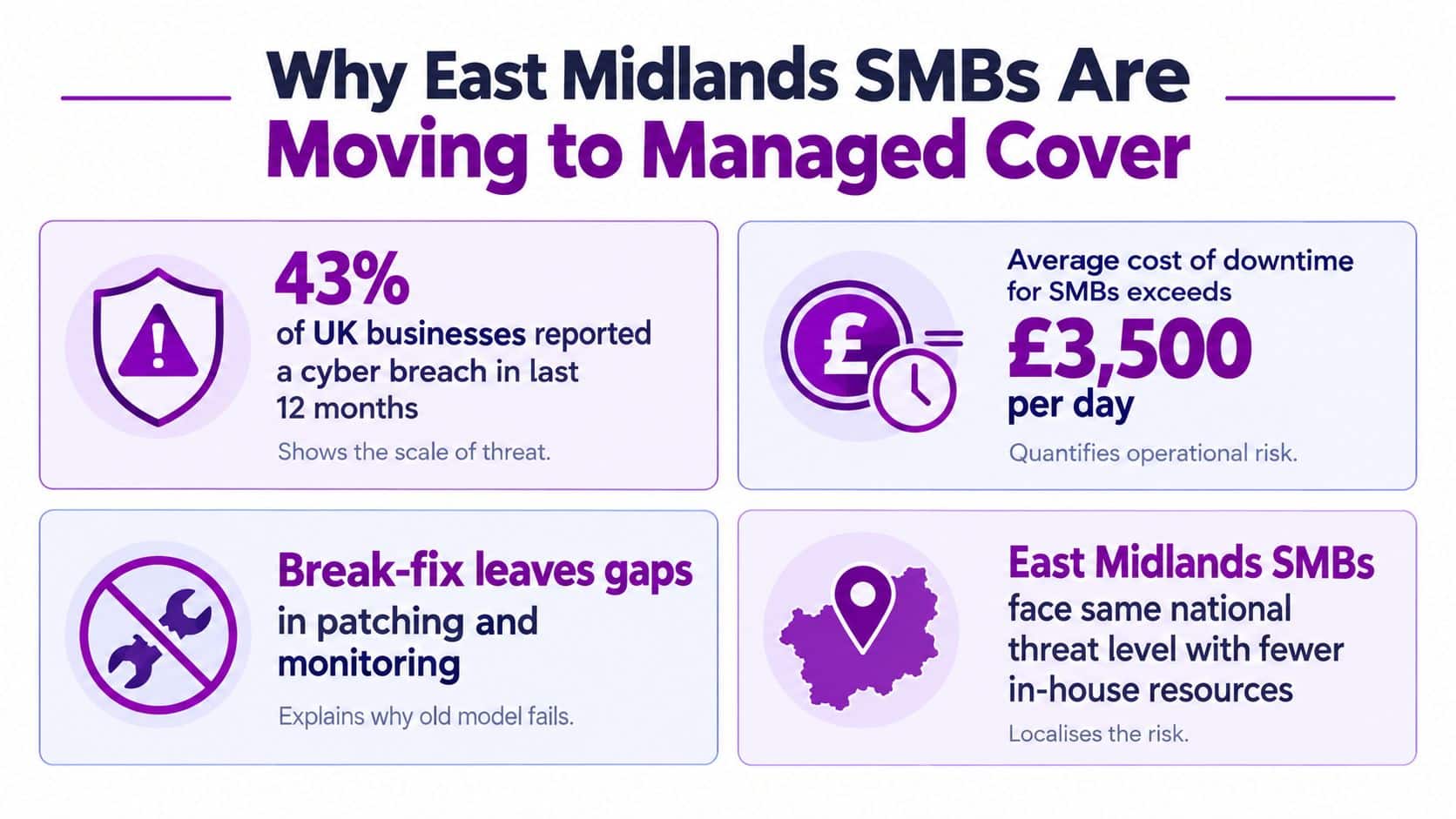
The UK government's Cyber Security Breaches Survey 2025 found that 43% of businesses and 30% of charities experienced a cyber security breach or attack in the previous 12 months. The point for an East Midlands SMB is practical: security controls need ownership every day, not attention only after an alert.
Phishing remains the most common attack type, but the wider risk includes compromised accounts, unpatched devices, weak recovery processes and unprepared users. Manufacturers around Derby and Leicester, logistics firms near major transport routes and professional services businesses handling sensitive client data face different exposures. Each still needs controlled identity, patching and recovery processes.
The government's separate 2025 analysis estimated the average cost of the single most disruptive breach at £3,550 for UK businesses. It also estimated average annual cyber-crime cost at £990 per affected business, rising to £1,970 when phishing-only cases were excluded, as reported in the government analysis of cyber security breaches and cyber crime. These are averages, not a forecast for your company. They do show why a managed service should be assessed against interruption, recovery and governance risk, not only against an employee salary or support-call fee.
Break-fix has a timing problem
Break-fix support begins after somebody notices a fault. The underlying event may have started earlier, while a user approved a malicious sign-in, a device missed updates or a backup stopped working. An internal contact may know the business well, but one person cannot maintain continuous oversight across every endpoint, identity event, vulnerability and recovery test.
Managed cover assigns that work to a defined operating process through monitoring, patching, identity protection, backup ownership and incident response. It does not remove risk or transfer every management decision. It gives the MD or IT manager clear accountability when several failures arrive together.
The UK managed services market has matured, but size does not prove quality. Government research estimated 12,867 active MSPs as of March 2025, employing 343,762 people, with about £51 billion in annual revenue and £22.3 billion in GVA. The market remains dominated by micro and small firms, so interrogate providers directly: who owns your incident out of hours, how is recovery tested, and what evidence proves the controls operate? Managed IT is a resilience and governance decision, not merely a technology purchase.
Real Business Benefits Beyond the Sales Pitch
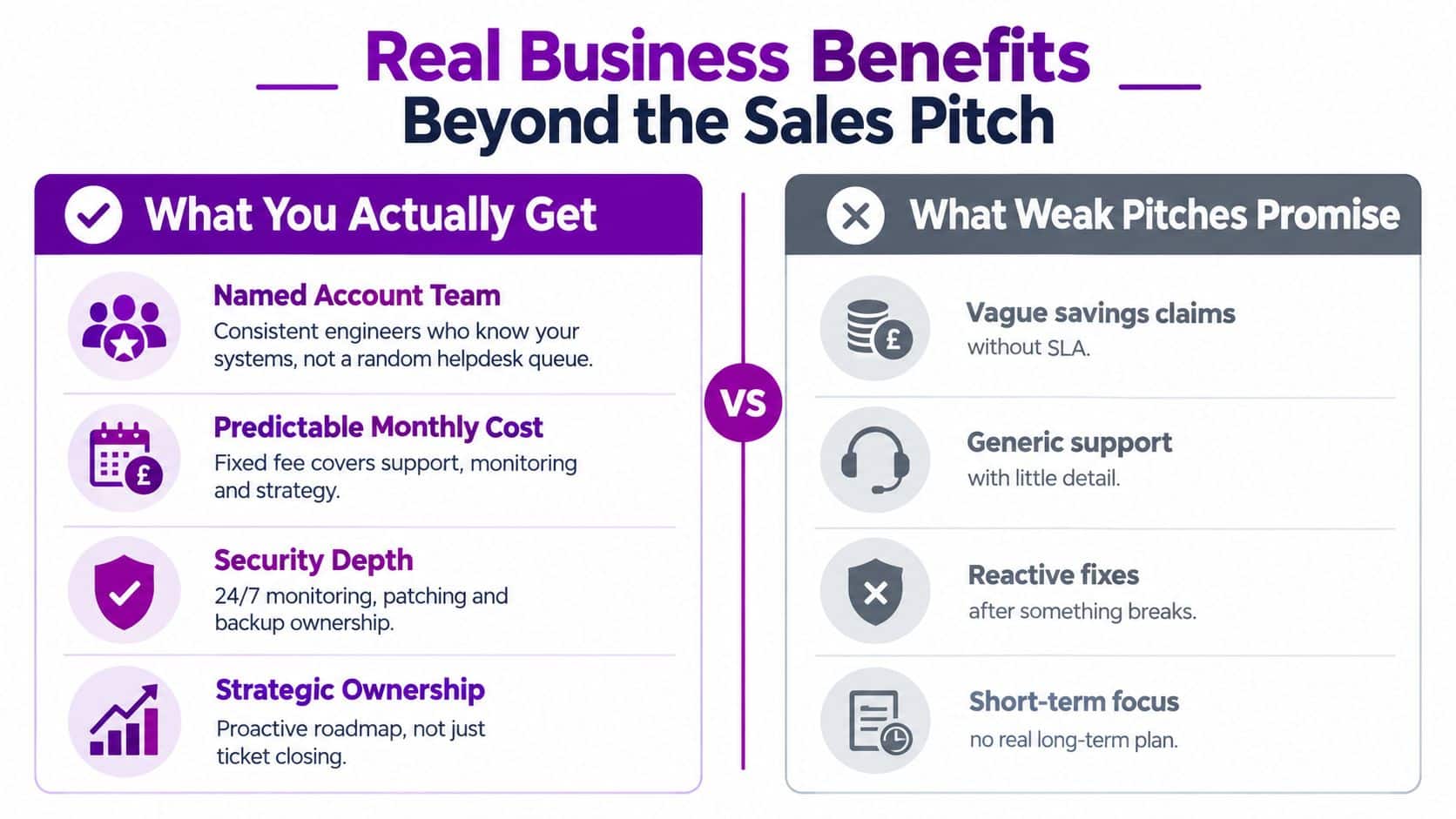
“Save money on IT” is a weak buying argument. A fully managed IT service may cost more than occasional break-fix support during quiet months. The stronger case is clear ownership, predictable planning and deeper control coverage, particularly for an East Midlands business where an outage can disrupt production, logistics, customer service or a second site.
A named account team should understand your servers, Microsoft 365 tenant, endpoints, connectivity, applications and business priorities. That reduces the time spent explaining the same environment during an incident. It also gives internal staff more capacity for reporting improvements, process automation and new-site work.
Predictability is a management benefit
A fixed monthly arrangement makes technology expenditure easier to plan when the contract defines its boundaries. Routine support can sit in the operating budget, while migrations, hardware replacement and strategic projects receive separate approval. Hardware, licences and major changes still require proper commercial treatment, so ask the provider to identify exclusions before signing.
Security depth is another substantial benefit. Managed detection and response, Microsoft Entra Conditional Access, MFA enforcement, endpoint detection and response, tested backups and dark web monitoring all require tooling, ownership and regular attention. An internal generalist may understand these controls, but maintaining them alongside user support and infrastructure work is difficult.
The business case is strongest when the provider owns controls you would otherwise leave incomplete.
Government cyber-security sector analysis recorded around £6.2 billion in cyber-security-related revenue for service providers including MSPs and MSSPs in 2024, rising to roughly £7.4 billion in 2025. Its 2026 analysis estimated 2,603 active cyber security firms and £14.7 billion in annual sector revenue. The UK cyber security sectoral analysis reflects the growing role of managed security operations within wider IT delivery.
Independent UK SME research found that 91% of SMEs said managed IT services benefited their business, with security the top reported benefit at 51%, followed by cost savings and higher availability. Treat that as market feedback, not a promise for your organisation. Require evidence of MFA coverage, EDR deployment, log retention, patch latency, backup immutability and incident handling.
Governance should appear in the service as a reliable record of what you have, who owns it and whether critical controls are working. Asset registers, quarterly business reviews, recovery documentation and audit-ready evidence can support Cyber Essentials or ISO 27001 work. Ask who maintains each record, how often it is reviewed and what happens when a control fails.
How UK Managed IT Pricing Models Compare
UK proposals usually use one of three structures, sometimes combined with a co-managed retainer. The headline price tells you very little until you know whether security, backup, projects, licences and out-of-hours support sit inside or outside the agreement.
Compare the commercial shape
| Pricing Model | Typical Inclusions | Common Hidden Costs | Best Fit |
|---|---|---|---|
| Per user per month | Helpdesk, user administration and agreed Microsoft 365 support | Onboarding, project hours, premium security tools, hardware and licence pass-through | Businesses with a predictable user base and broadly standard devices |
| Per device | Endpoint support, monitoring and device management | Servers, network equipment, mobile devices, backup, new devices and after-hours work | Smaller estates where device ownership is easy to audit |
| All-inclusive fixed fee | A wider package covering users, devices, monitoring, security, backup and account management | Major projects, specialist applications, hardware and work outside the service catalogue | Businesses seeking clear ownership and predictable operating cover |
| Co-managed retainer | Defined access to external specialists alongside an internal IT manager or team | Extra hours, emergency work, security platforms and unclear responsibility boundaries | Organisations retaining internal knowledge but needing additional capability |
There isn't a reliable universal benchmark for a quote without knowing your users, devices, sites, applications, security requirements and support hours. Treat any “typical UK price” presented without that context with suspicion. A low per-seat figure can exclude the very controls that make managed support valuable, including EDR, immutable backup, vulnerability work, strategic reviews and incident response.
Before comparing suppliers, read managed IT support pricing in the UK alongside the actual proposal. Then request a written scope containing:
- Included services: Name each platform, device class, backup workload and security function.
- Response commitments: State severity levels, response targets, escalation and service hours.
- Exclusions: Identify project work, cabling, licences, hardware, travel and third-party supplier charges.
- Commercial controls: Check onboarding fees, annual increases, price-lock terms and minimum commitments.
- Exit arrangements: Confirm notice periods, data return, documentation and migration assistance.
Assess the quote against the cost of interruption and the consequences of an unowned control. A slightly higher fee may be sensible if it buys tested recovery, stronger identity protection and a team that responds before an outage becomes a board-level problem.
How to Choose the Right Provider in the East Midlands
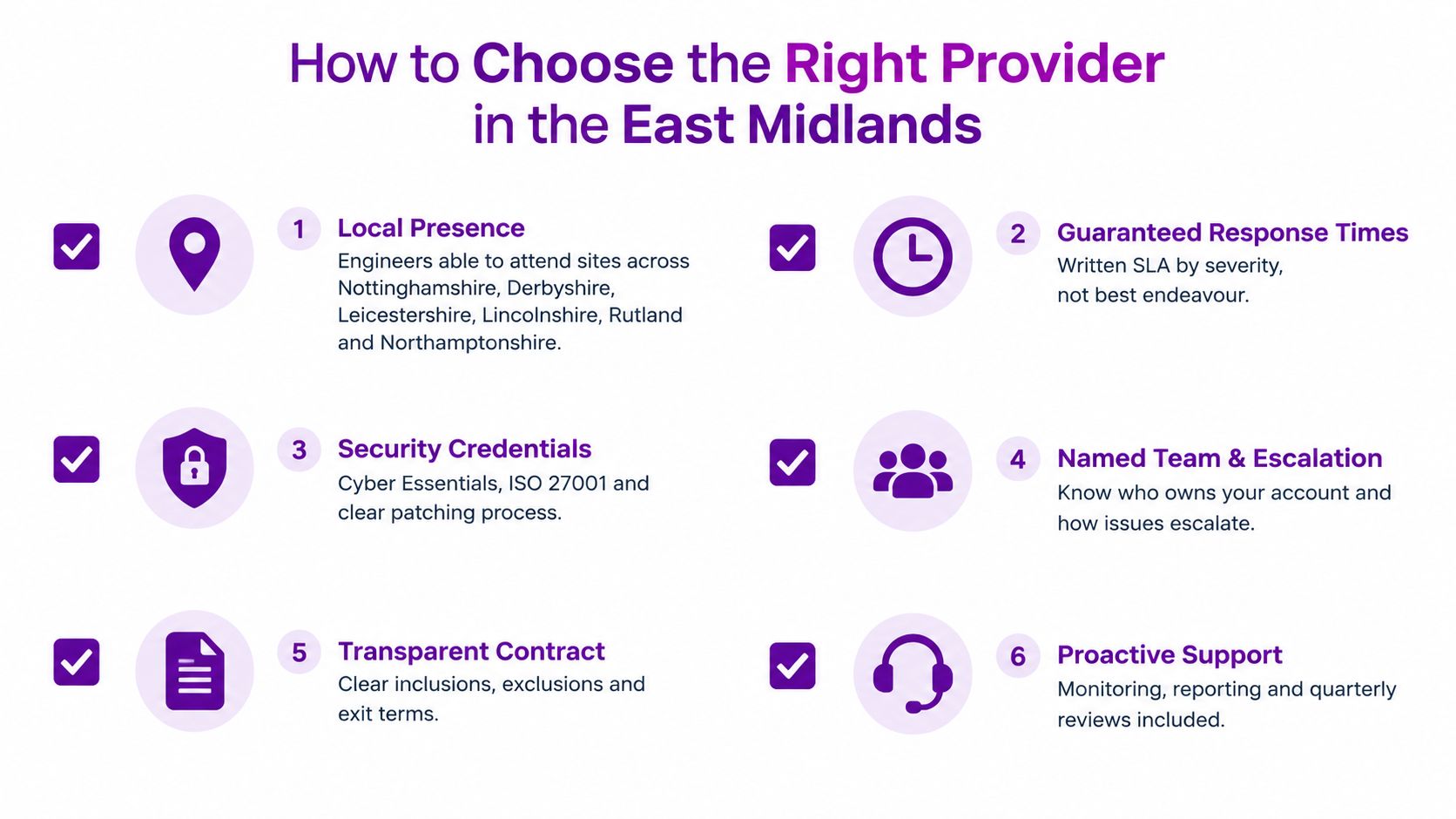
Local presence matters when a remote fix isn't enough. Shortlist providers that can explain how engineers reach sites in Nottinghamshire, Derbyshire, Leicestershire, Lincolnshire, Rutland and Northamptonshire. “We cover the East Midlands” should mean a practical on-site process, not just a sales territory on a website.
Shortlist against evidence
- Local engineering cover: Ask whether an engineer can attend Nottingham, Derby, Leicester or Lincoln when remote hands cannot resolve the fault. Clarify availability for warehouses, factories and multi-site operations.
- Microsoft capability: Look for relevant Microsoft Solutions Partner designations, including Modern Work or Security, and ask which engineers hold current certifications. A badge doesn't replace proof of delivery, but no evidence should concern you.
- Security operations: Require more than relabelled antivirus. Ask how the provider manages MFA, EDR, patching, vulnerability findings, alert triage, privileged access and incident escalation.
- Written SLA: Check response times by severity, resolution targets, uptime commitments and the definition of billable work. “Best endeavours” is not a service level.
- Account ownership: Insist on a named account manager, regular service reviews and a documented escalation route. You should know who discusses risk and roadmap decisions with your leadership team.
- Relevant references: Speak to similar-sized East Midlands organisations in manufacturing, logistics, professional services or the charity sector. Ask how the provider performed during an outage, not whether they were friendly during onboarding.
Check credentials such as Cyber Essentials Plus and ISO 27001 where they fit your risk and procurement requirements. Also ask for insurer-friendly evidence, including MFA records, backup test results and incident procedures. UK government-backed research says 59% of SMEs have cyber insurance coverage limits up to £1 million, as reported in Insuring Resilience. Your provider should help you understand whether its controls support policy requirements, rather than implying that managed support automatically reduces premiums.
For wider market research beyond the region, a comparison of security and cloud providers Atlanta can help you see how other provider guides assess capability. The buying criteria remain local, operational and evidence-based.
The IT service provider guide from F1Group offers another reference point. Finally, confirm scalability, subcontracting, licence ownership and exit terms before you sign.
Ask the shortlisted provider to show a sample service report. It should make clear what was monitored, what was patched, which risks remain open and what decisions require your attention.
Questions That Expose Weak Providers Before You Sign
Treat the sales meeting as a procurement interview. A polished presentation can hide weak escalation, unclear subcontracting and a security service that amounts to little more than antivirus alerts.
Put these questions in writing and insist on direct answers:
- What is your SLA by severity, and how do you measure it? Ask for response, restoration and resolution definitions, plus examples from service reports. A clock starts at a defined point, so make sure the contract says when.
- Who is my named account manager and what is the escalation path? You need an accountable person and a route beyond the first-line queue. Ask who owns a recurring issue that crosses infrastructure, security and application teams.
- How do you handle out-of-hours support and on-site cover? Find out whether monitoring continues outside office hours, who triages alerts and how local engineering attendance works. Don't accept “24/7” without understanding whether it means staffed response or automated notification.
- What security and backup ownership do you take? Ask for the patching process, MFA enforcement, EDR coverage, privileged access controls, immutable backup design, restore testing and incident response responsibilities.
- What happens if we want to leave? Confirm the notice period, data handover format, configuration ownership, documentation and assistance available during migration. A provider that makes exit difficult is increasing your operational risk.
Test the uncomfortable areas
Ask where your data is held, how the provider supports UK GDPR obligations and whether tickets are subcontracted overseas overnight. Request evidence of Cyber Essentials Plus, Microsoft Solutions Partner status and a sample monthly report. Don't confuse a certificate with complete protection, but don't accept unsupported claims either.
The provider itself is part of your supply chain. A 2026 UK and Ireland MSP survey reported that 75% of managed service providers had suffered at least one breach in the previous 12 months, 54% had been breached two or more times, and 32% had experienced three or more breaches. Those figures come from the MSP cyber security report. Ask how the supplier protects its remote management tools, privileged accounts, backups and customer separation.
A provider that dodges a clear question about access, evidence or exit is giving you useful information before the contract begins.
Finally, request three references from similar East Midlands businesses and call them. Ask what went wrong, how quickly the provider escalated it and whether the monthly reports matched reality. You're not looking for a flawless supplier. You're looking for one that knows its weaknesses, owns its commitments and can prove its controls.
Get Tailored Managed IT Support Across the East Midlands
Don't choose a fully managed IT service by comparing generic per-user figures alone. Start with the business you need to protect, the systems that keep revenue moving, the risks your insurer or customers care about, and the work your internal team can realistically own.
F1Group supports manufacturers, professional services firms and charities across the East Midlands, from Nottingham to Loughborough and Derby to Northampton. Its services include fully managed IT, co-managed support, cyber security and Microsoft 365 management, delivered through a local helpdesk with on-site engineering when a remote resolution isn't enough.
The sensible first step is a short audit of your current setup. That should cover your Microsoft 365 and Azure environment, endpoints, backup arrangements, identity controls, applications, support history, risk appetite and budget. The resulting proposal should reflect your operation rather than reproduce a standard package.
If you're an MD or IT manager, ask for a recommendation that distinguishes routine service from project work and states exactly who owns security, recovery and supplier escalation. If your current provider can't answer those questions, start the review before the next outage forces it.
Call 0845 855 0000 today or send a message through the contact page to discuss your requirements with F1Group.
F1Group provides fully managed IT, co-managed support, Microsoft 365 management and cyber security services for East Midlands organisations that need clearer ownership and stronger resilience. Visit F1Group to request a conversation about your systems, risks and support requirements, then phone 0845 855 0000 today or send us a message.