
If your team is exporting data from one system, cleaning it in Excel, then pasting it into another, you already know the problem. The software technically works, but the business has to work around it. That's where time leaks out, errors creep in, and growth starts to feel harder than it should.
Across the East Midlands, I see the same pattern in manufacturers, charities, distributors, and service firms. They've bought solid products, often from reputable vendors, but the systems don't quite match how the organisation operates. Sales lives in one place, operations in another, reporting in a third, and nobody fully trusts the numbers on the dashboard by Friday afternoon.
Bespoke software development services solve that mismatch. In plain English, bespoke software is software built around your business rather than forcing your business to bend around somebody else's product. It's the difference between an off-the-rack suit and one cut to fit your shape, your job, and the way you move.
Moving Beyond Off-the-Shelf Limitations
Most businesses don't wake up one morning and decide they need bespoke software. They get there gradually. A spreadsheet becomes a process. A workaround becomes policy. A member of staff becomes the only person who understands how orders move from enquiry to invoice.
That setup can survive for a while. It doesn't scale well.
When standard software stops being good enough
Off-the-shelf platforms do a lot well. They're quick to buy, familiar to many users, and often suitable for standard functions such as email, finance, and document storage. The trouble starts when your core process is unusual, or when several systems need to pass data between each other cleanly and automatically.
Typical warning signs look like this:
- Manual rekeying: Staff type the same customer, product, or job data into multiple systems.
- Spreadsheet dependency: Reporting only works because someone downloads and tidies data every week.
- Hidden bottlenecks: One person knows the workaround, and work slows down when they're away.
- Poor fit: Teams change their process to suit the software, even when that adds friction for customers.
- Patchwork integrations: Different tools “sort of” connect, but only with exceptions and caveats.
A useful comparison is this guide to software solutions, which lays out the practical differences between custom and packaged systems. It's worth reading if you're deciding whether your issue is a small configuration job or a genuine case for building something bespoke.
Bespoke software isn't about replacing every system you own. It's about fixing the parts that create drag.
What bespoke software development services actually include
For East Midlands firms using Microsoft tools, bespoke usually means one or more of these:
- Custom applications: Tools built for a specific internal workflow, such as job tracking, field service updates, or approvals.
- System integration: Connecting Microsoft 365, Dynamics 365, Azure, Power Platform, and older line-of-business systems.
- Automation: Removing repetitive steps with Power Automate, APIs, and event-driven workflows.
- Reporting and visibility: Creating one reliable view of operations with custom dashboards and controlled data access.
The important point is that bespoke doesn't have to mean starting from scratch. Often the strongest approach is to keep what already works, then build the missing layer that joins it all together.
The Business Case for Custom-Built Software
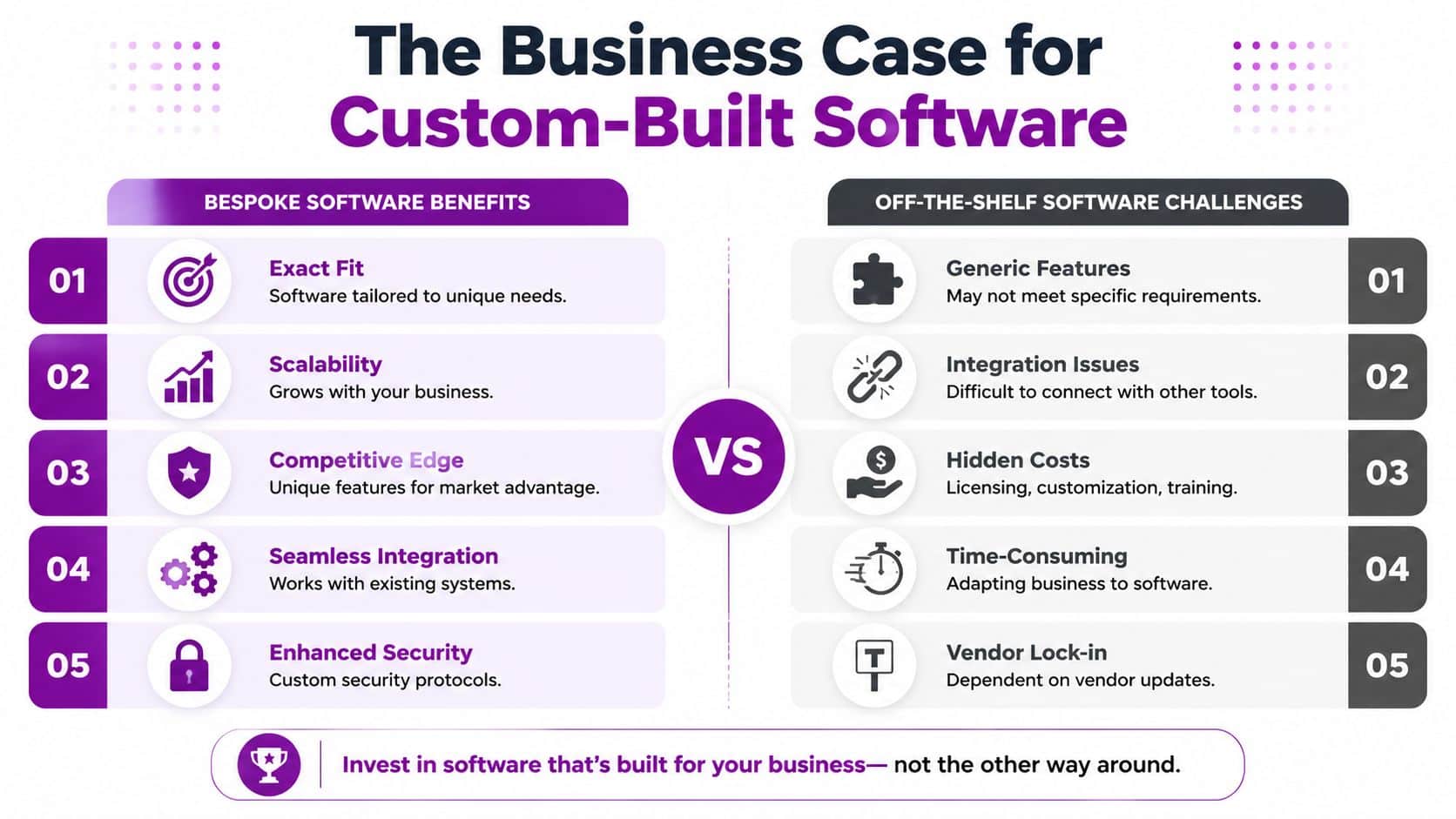
Purchasing software seems more secure because the initial costs appear lower. Developing custom solutions feels more hazardous because the investment is more apparent. In practice, the fundamental question isn't "Which is cheaper this quarter?" It's "Which option removes friction from the business for the next several years?"
Where bespoke earns its keep
Custom-built software makes commercial sense when the process matters to your margin, your customer experience, or your compliance position. If the work is central to how you win and retain business, forcing it through generic software usually creates long-term cost.
The main gains tend to come from four places:
- Operational fit: The software mirrors the way your team works.
- Ownership and control: You decide the roadmap, not a vendor selling to a mass market.
- Integration: Data moves between systems without people acting as the middleware.
- Differentiation: Competitors can buy the same package. They can't buy your process.
A lot of leaders underestimate that last point. Bespoke software can become a business asset in its own right. If your service model is faster, more accurate, or easier for customers to use because the underlying software is designed around it, that's not just IT improvement. It's commercial advantage.
ROI is usually tied to automation first
The strongest returns often come from removing repetitive handling, duplicate entry, and manual reconciliations. According to a 2025 UK Department for Business and Trade report cited here, 68% of UK SMEs adopting bespoke software reported a 25-35% improvement in process automation and cost savings within the first year.
That rings true in practice. The biggest early wins usually aren't glamorous. They come from simpler quoting, cleaner approvals, fewer handoffs, and better information at the point of decision.
Practical rule: If a task is repeated often, touches several systems, and still depends on human memory, it's usually a strong candidate for bespoke automation.
What off-the-shelf software often gets wrong
Packaged software isn't the enemy. It's just designed for broad appeal. That means compromise is built in.
Common problems include:
| Off-the-shelf issue | What it looks like in the business |
|---|---|
| Generic workflow | Teams add side processes to make the product usable |
| Vendor roadmap limits | You wait for features that may never arrive |
| Licensing sprawl | Costs rise as users, modules, or connectors are added |
| Weak integration | Staff still move data by hand between systems |
| Lock-in risk | Changing provider becomes expensive and disruptive |
The better view is not bespoke versus packaged as a pure either-or choice. The smart move is usually selective. Use standard platforms for standard needs. Build bespoke where your business needs precision, speed, or a tighter fit.
Bespoke Software in Action for East Midlands SMEs
Theory is tidy. Real businesses aren't. They've got legacy systems, supplier demands, seasonal peaks, compliance concerns, and teams who need tools to work on a busy Tuesday, not in a product demo.

In the East Midlands, uptake has been strong. East Midlands Chamber of Commerce statistics cited here state that bespoke development spending grew 28% year-over-year in 2025, reaching £850 million regionally, driven by manufacturing and retail businesses needing custom integrations.
Manufacturing in Leicester or Derby
A manufacturer might already have Dynamics 365 handling core ERP data but still rely on paper notes or disconnected spreadsheets on the shop floor. In that setup, production updates arrive late, planners work with stale information, and customer service can't give a confident answer on delivery status.
A bespoke Power App can solve that neatly. Staff record progress at source, supervisors see live status, and data flows back into the wider system without rekeying. The gain isn't just convenience. It's fewer blind spots between order intake, production, and dispatch.
Logistics around Grimsby or Newark
Logistics businesses often need something more specific than a standard transport module provides. Route changes, proof of delivery, customer updates, and internal exceptions all need handling in one flow.
That's where a custom portal or mobile app earns its place. Drivers can update status on the move, office teams can see exceptions quickly, and customers can check progress without ringing the operations desk. If that platform also feeds Microsoft reporting tools, managers stop arguing about whose spreadsheet is correct.
Charities and service organisations
Larger charities often have a different problem. They're balancing donations, volunteers, safeguarding, service delivery, and reporting obligations, often with limited internal technical capacity. Generic tools can cover parts of that, but they rarely fit the whole picture.
A bespoke system can connect volunteer records, case notes, service activity, and reporting in a way that respects role-based access and makes daily administration less brittle. That matters when the organisation's work depends on trust, continuity, and clear governance.
For organisations comparing options, software solution approaches like these are often most useful when they focus on joining existing systems together rather than replacing everything at once.
A good bespoke project feels less like “new software” and more like removing daily irritation from the business.
Your Bespoke Software Development Journey
One reason leaders delay software projects is uncertainty. They're not worried about the idea. They're worried about the process turning vague, expensive, and difficult to control.
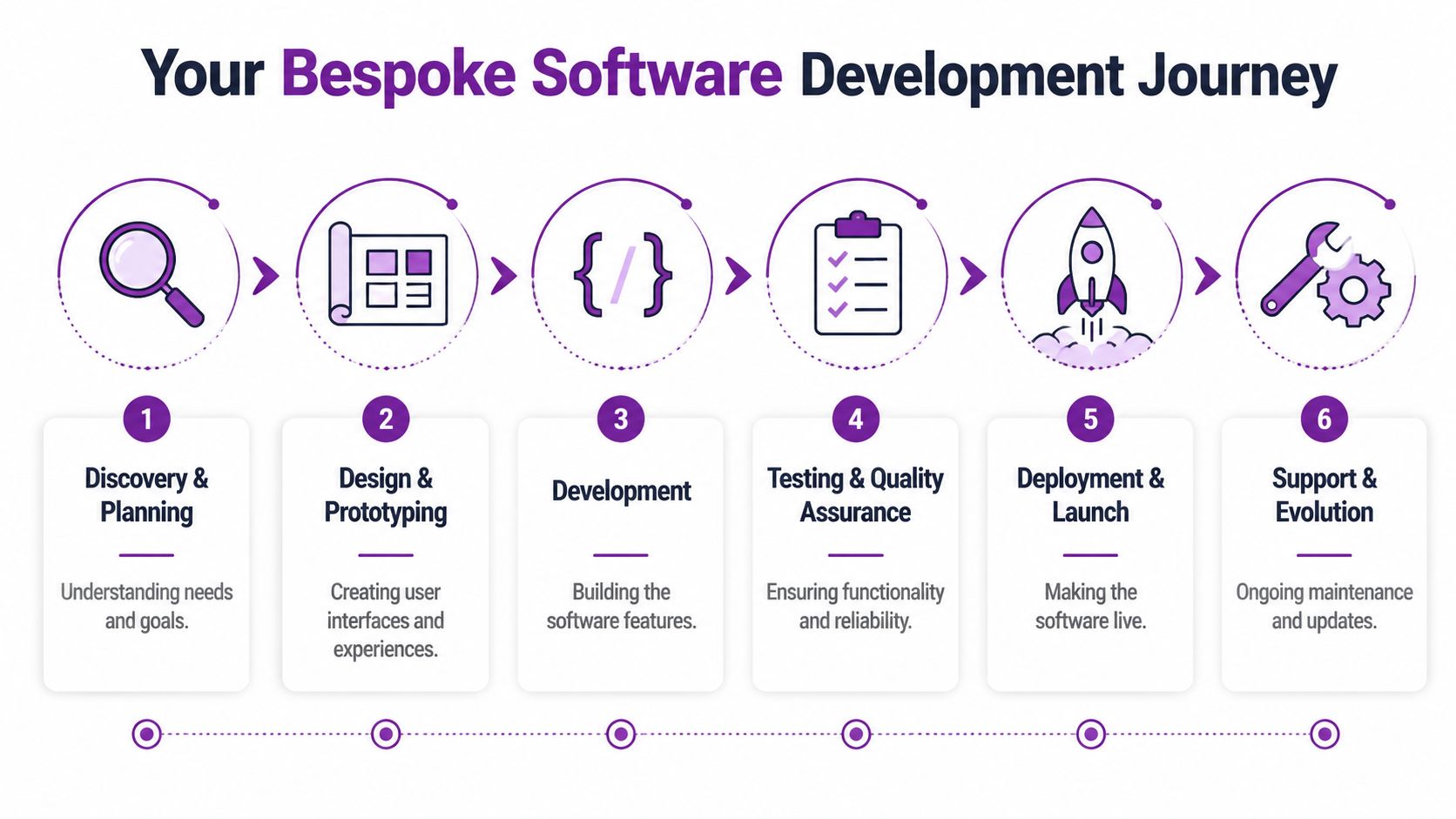
A disciplined development lifecycle fixes that. Good bespoke software development services don't start with code. They start with clarity.
Discovery and planning
At this stage, a project either becomes manageable or goes off track. The aim is to understand the authentic process, not just collect a wish list. That means identifying users, pain points, exceptions, approvals, data sources, and what success looks like in operational terms.
Useful outputs at this stage include:
- Process mapping: How work happens now, including bottlenecks and manual fixes.
- Requirements shaping: Which needs are essential, which are desirable, and which should wait.
- Technical review: What systems the new solution must connect to.
- Delivery scope: What belongs in phase one and what doesn't.
Design and prototyping
Once the business need is clear, the next step is to show how the software will work before expensive build decisions are made. Wireframes, prototypes, and user journeys matter because they flush out misunderstandings early.
This is the point where stakeholders should challenge assumptions. If a screen takes too many clicks, or a workflow ignores a real-world exception, it's far cheaper to fix on paper than in production.
What works: Short feedback loops with the people who'll use the system every day.
What doesn't: Designing around management assumptions without checking operational reality.
Build, test, and launch
Development should move in controlled increments. Features are built, reviewed, adjusted, and tested against real business scenarios. Proper testing isn't just “does the button work?” It's “does this process hold up when the data is messy, the user is busy, and an exception appears halfway through?”
A sound build phase includes:
- Incremental development so progress is visible.
- Quality assurance against business logic, integrations, and permissions.
- User acceptance testing with the people who'll depend on the system.
- Deployment planning covering training, support, and cutover.
After launch, the work isn't finished. It changes shape.
Support and evolution
Bespoke software should evolve with the organisation. Teams learn what they want to refine once they start using the system in real conditions. New reporting needs emerge. Regulations shift. Internal processes change.
That's why application lifecycle management matters. A useful reference point is this overview of application lifecycle management, especially if you're weighing how a system will be maintained after the initial delivery. The long-term value comes from treating the application as a living business tool, not a one-off project file.
Unlocking Potential with Microsoft Technologies
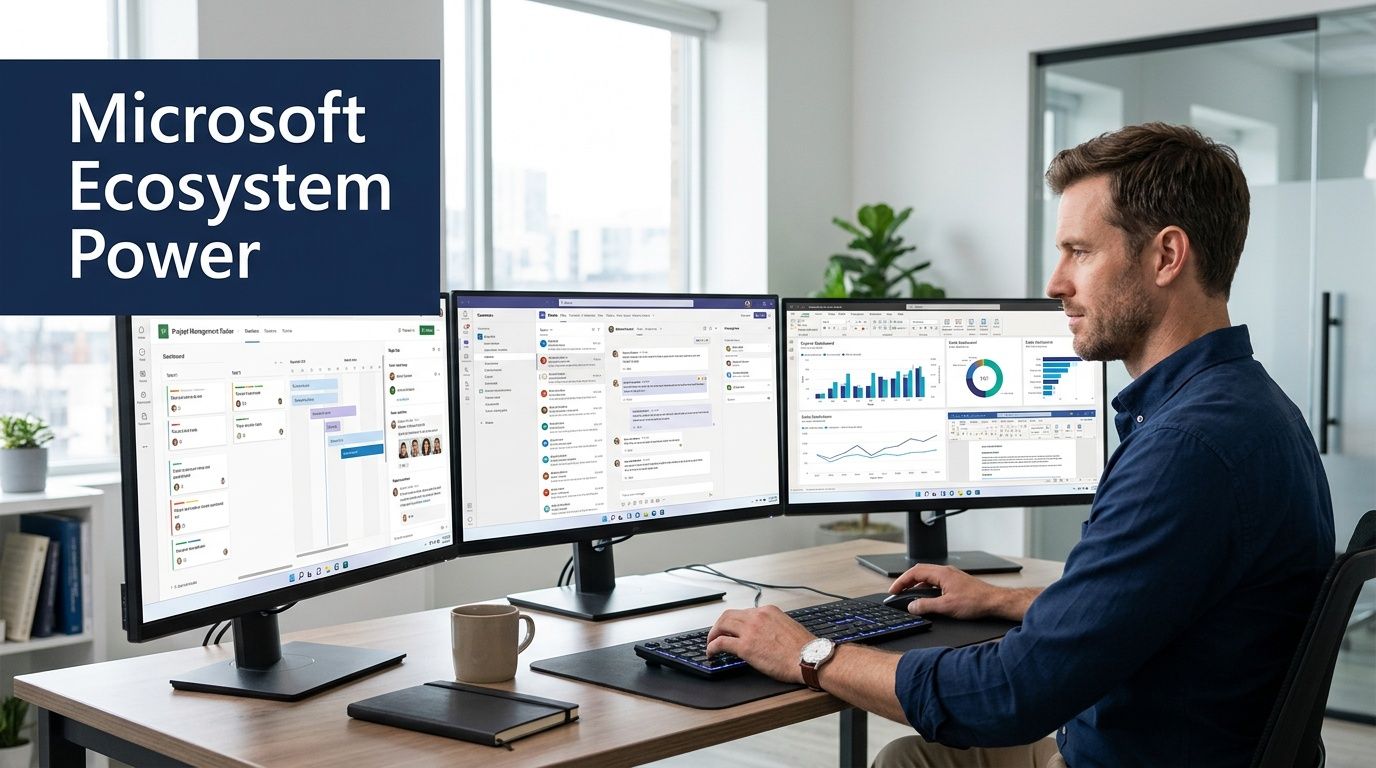
For many East Midlands businesses, Microsoft is already the spine of the IT estate. Microsoft 365 runs collaboration. Azure supports cloud infrastructure. Dynamics 365 manages customer or operational data. Power Platform fills smaller workflow gaps. The missed opportunity is that these tools often sit side by side without being fully joined up.
That's where bespoke development inside the Microsoft ecosystem becomes especially effective.
Why Microsoft-based bespoke projects often land well
The business already knows the environment. Users are familiar with Microsoft sign-in, security controls, and common interfaces. That reduces friction compared with introducing a completely separate platform.
Bespoke software development services built around Microsoft typically use:
- Azure for hosting, identity, security, APIs, and scalable application services
- Power Apps for custom internal applications
- Power Automate for workflow automation between systems
- Power BI for operational and management reporting
- Dynamics 365 as the source of truth for customer, service, sales, or HR processes
When these pieces are used properly, the result isn't just a custom app. It's a joined-up operating model.
Dynamics 365 is often the turning point
A lot of firms have Dynamics 365 in place but only use the standard forms and flows. That's a decent start, but it often leaves speed and usability on the table. Bespoke work around Dynamics 365 is usually about shaping the process to suit the business instead of asking staff to click through generic screens.
According to this Dynamics 365 bespoke integration reference, bespoke software for Microsoft Dynamics 365 integrations can enable organisations to achieve up to 40% faster data processing in custom CRM workflows compared to standard configurations, by tailoring Power Automate flows and Azure Logic Apps to specific business logic.
That matters in practical terms. Faster processing means fewer waits between action and result. Sales teams update records without lag. Service teams see cleaner information. Managers get reporting that reflects what is happening, not what eventually syncs overnight.
Integration is where the value compounds
The strongest Microsoft-based solutions usually connect old and new. A business might keep a legacy stock system, use Dynamics 365 for customer activity, surface mobile tasks in Power Apps, and feed leadership dashboards through Power BI. That's a sensible architecture if the integration layer is planned properly.
For businesses mapping those connections, integrating software systems is often the primary project, not the interface itself. In the East Midlands, providers such as F1Group work in that Microsoft-focused integration space alongside internal IT teams and other specialist partners.
If your staff are still exporting CSV files between Microsoft tools and older systems, you haven't finished the integration job.
Pricing Models and Finding Your Ideal Partner
Cost matters, but the cheapest project rarely stays the cheapest. In bespoke work, poor discovery, loose governance, or weak technical decisions create expenses later that don't appear in the initial quote.
For East Midlands SMEs, this UK pricing reference notes that average bespoke project spend sits between £45,000 and £120,000, which is 20% below London averages, yet 62% report ROI delays beyond 18 months without proper Microsoft ecosystem integration such as Power Platform. That's a useful benchmark because it shows two truths at once. Bespoke can be accessible outside London, and integration quality has a direct effect on payoff.
Fixed price versus time and materials
Neither model is automatically right. The best choice depends on how clear your scope is and how likely your requirements are to move once users see the solution take shape.
| Model | Best For | Budget Control | Flexibility |
|---|---|---|---|
| Fixed Price | Clearly defined projects with stable requirements | Strong at the start if scope is tightly agreed | Lower once build begins |
| Time and Materials | Complex projects where needs may evolve during delivery | Requires active oversight and prioritisation | Higher, with easier change handling |
A fixed price arrangement suits projects where the process is understood, the integrations are known, and stakeholders can make decisions early. If the scope is fuzzy, fixed price often becomes a false comfort. You'll either get a padded quote or a strained relationship when change requests start arriving.
A time and materials model works better when discovery is likely to reveal process changes, exceptions, or technical unknowns. That flexibility is valuable, but only if there's proper governance. Without that, costs can drift because nobody is making firm priority calls.
What to ask before you appoint anyone
Choosing a partner is usually more important than choosing a framework. The wrong supplier can make sensible technology feel risky. The right one makes a complicated project feel controlled.
Use this checklist when you speak to any provider:
- Ask how they run discovery: If they jump straight to features and price without understanding process, that's a warning sign.
- Ask who owns architecture decisions: You want clarity on hosting, integrations, security, and future support.
- Ask how they handle change: Requirements always move a bit. The issue is whether that movement is managed cleanly.
- Ask how testing is done: Real business scenarios matter more than generic testing language.
- Ask about support after go-live: Software needs ownership once it's live, not just during build.
- Ask about Microsoft capability: If your estate is centred on Azure, Dynamics 365, Microsoft 365, or Power Platform, the partner should be fluent in that stack.
- Ask about security and compliance practice: UK GDPR considerations, access control, and auditability should be built in from the start.
What good partner behaviour looks like
A dependable provider will challenge vague requests, narrow scope when needed, and talk plainly about trade-offs. They won't promise every feature immediately. They'll help you decide what belongs in the first release and what should wait until the business has learned from real usage.
The local factor also matters more than some buyers admit. When your provider understands how regional firms operate, whether that's a manufacturer in Leicester, a charity in Newark, or a distribution business near Grimsby, discovery tends to be sharper. The examples are more relevant, and the assumptions are better grounded.
A strong software partner doesn't just ask what you want built. They ask what the business needs to stop doing manually, badly, or twice.
Conclusion Your Path to a Digital Advantage
If your current systems are slowing down work, obscuring data, or forcing staff into workarounds, the issue usually isn't effort. It's fit. Software that only partly matches the business will keep producing friction, no matter how hard good people work around it.
That's why bespoke software development services matter. They give you a way to shape technology around the way your organisation sells, delivers, reports, and grows. In the Microsoft ecosystem especially, a well-designed bespoke solution can connect tools you already own and turn them into something far more useful day to day.
The strongest projects are pragmatic. They don't replace everything. They fix the costly gaps, automate the repetitive parts, and create cleaner visibility across the business. Done properly, that gives you more than a new application. It gives you a digital asset that supports growth on your terms.
If you'd like to talk through whether bespoke software is the right fit for your organisation, speak to F1Group. Phone 0845 855 0000 today or send us a message to discuss your requirements.