
In 2024, software development contributed £10.3bn, or 18.5% of total UK business R&D spending, so custom software is a major investment channel rather than a niche IT activity. The practical decision for most East Midlands businesses is whether a bespoke build, Microsoft-native configuration, or a carefully controlled combination will deliver the required outcome with the least risk.
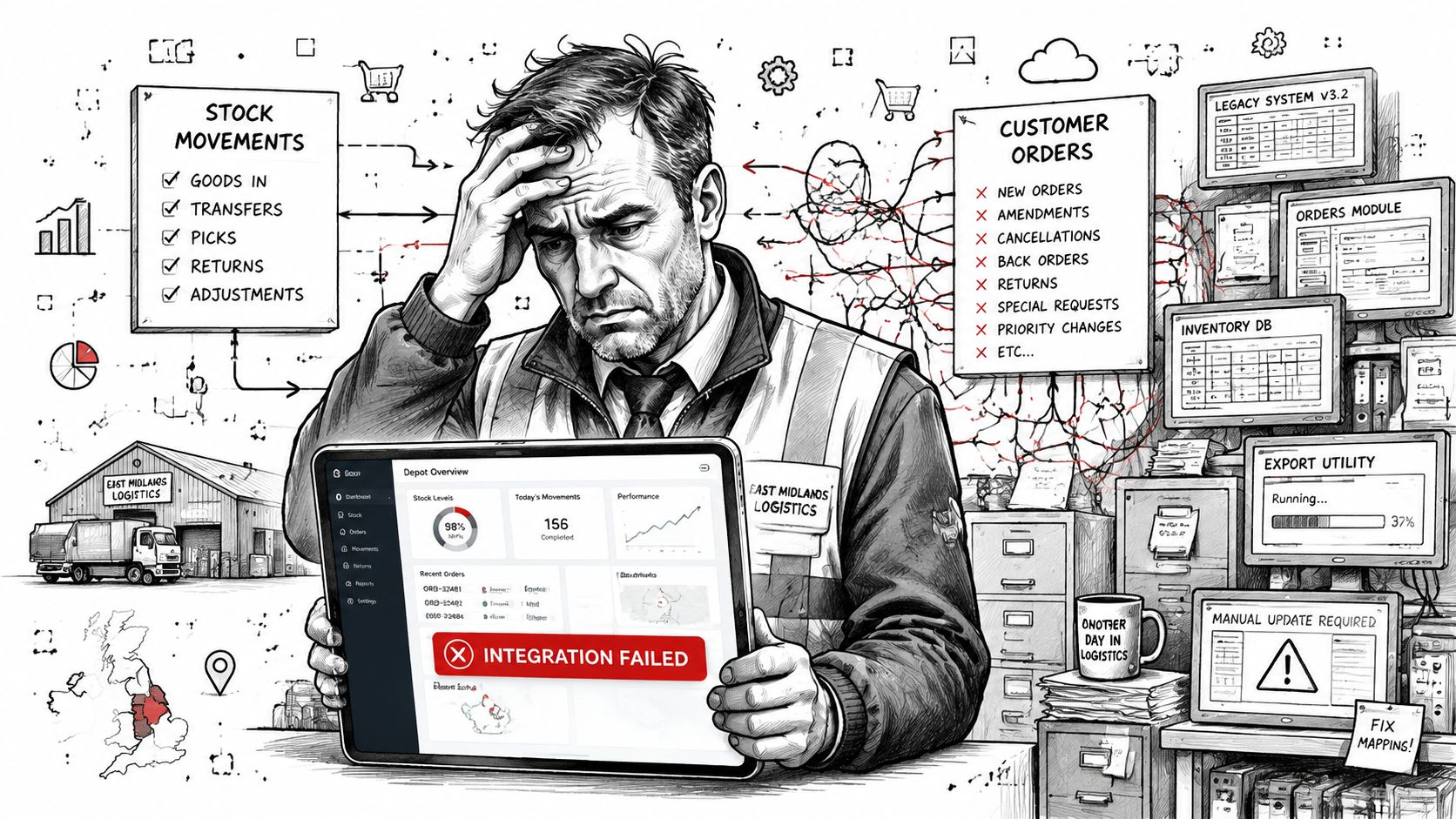
A Nottingham logistics manager might recognise the situation immediately. The warehouse platform handles stock movements, yet delivery routing sits in another system, customer updates arrive through email, and finance staff re-enter information into accounting software. A new customer then requests a report the vendor hasn't planned, leaving the operations team with spreadsheets and manual workarounds.
The software isn't necessarily poor. It was designed for a broad market, while the company's processes have become more specific. That's when the build-versus-buy question becomes commercial rather than technical. Should the business change its processes to suit a product, configure Microsoft tools around the existing workflow, or commission custom software development that connects everything properly?
Why East Midlands Businesses Outgrow Off-the-Shelf Software
Off-the-shelf software usually works well at the start. A growing manufacturer can adopt a stock package quickly, a professional services firm can install a standard CRM, and a logistics company can begin recording jobs without waiting for a development team. The difficulty appears later, when the organisation's competitive advantage depends on processes the product wasn't designed to support.
A Lincolnshire business might need production records, quality checks, despatch status and customer updates to move through one workflow. If its systems don't share data cleanly, employees copy information between screens, managers wait for reports, and errors become difficult to trace. The business pays for software, then pays again in administrative effort.
The warning signs appear in daily work
Look for friction rather than dramatic failure:
- Repeated data entry: Staff enter the same customer, order or job details into several systems.
- Spreadsheet dependency: Important operational decisions rely on files that are hard to govern, audit or update.
- Manual reconciliation: Finance or operations teams spend time checking whether two systems agree.
- Vendor limitations: A required report, approval route or integration remains unavailable because it isn't on the product roadmap.
- Process compromise: Employees follow the software's workflow instead of the workflow that makes commercial sense.
The UK software development sector has substantial capacity around these needs. The Data City figures reported in the UK custom software market overview estimate 11,055 companies, £50.9bn in turnover and 107,279 UK employees, alongside £2.5bn of investment funding and £40.8m of Innovate UK grant funding. The source reports average company growth of 9.8% per year and projects turnover could reach £66.3bn by 2027.
That scale matters to an East Midlands buyer. It means bespoke systems can be supported by specialist developers, integration partners and internal digital teams rather than treated as an isolated experiment. The question is not whether ready-made software has value. It's whether its limitations now cost more than a better-fitting operating model.
What Custom Software Development Actually Means
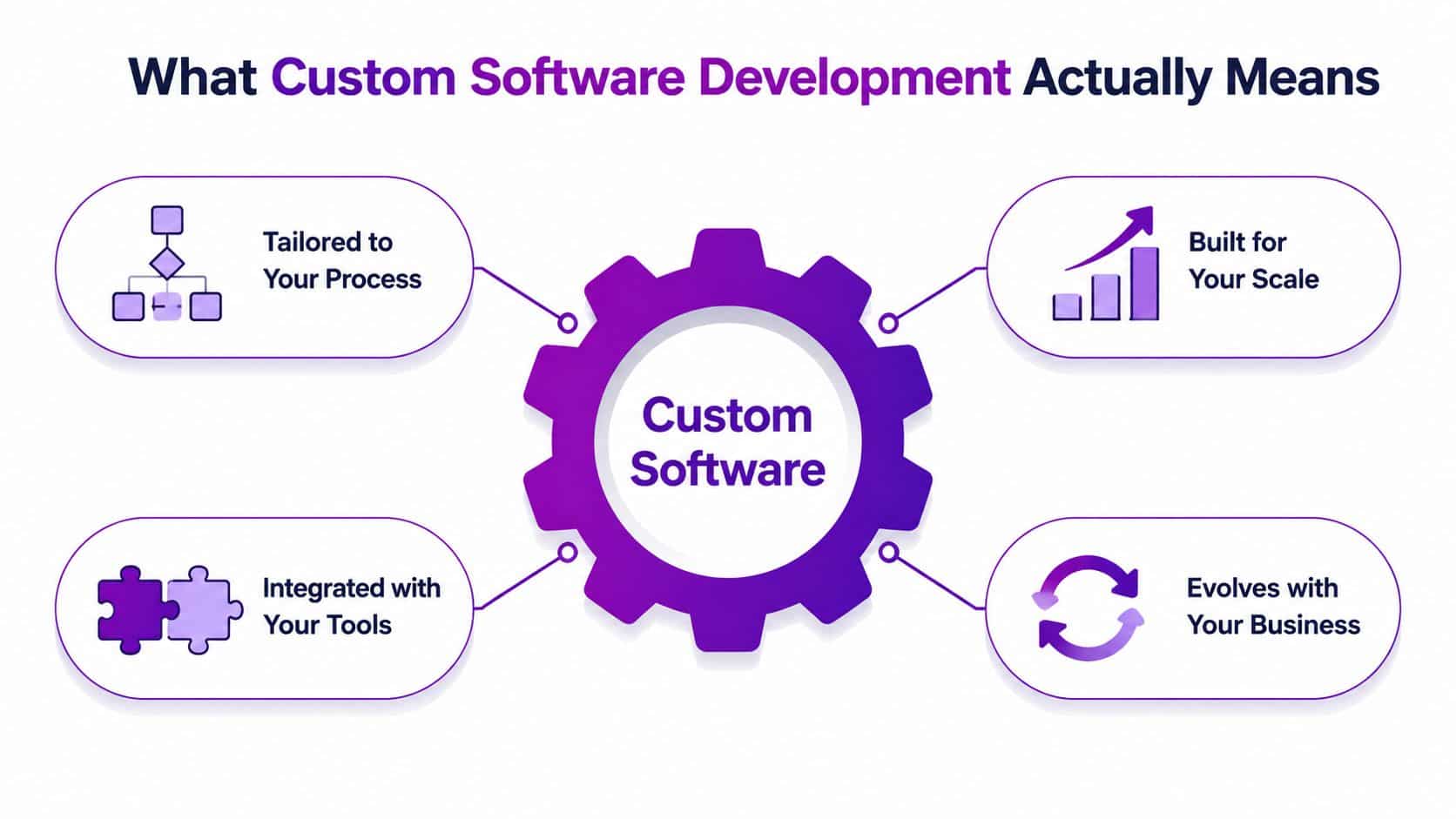
Custom software development is the design, engineering and delivery of an application around one organisation's processes, data and integration requirements. A team starts with how the business operates, then defines the workflows, permissions, data structures and connections the system must support.
An architect-designed house is a useful comparison. A show home offers speed and predictable features, but it was built for a generic buyer. A custom home begins with the plot, the household's routines and the constraints of the site. Bespoke software follows the same logic. It's shaped around the people who use it and the business decisions it must support.
The middle ground matters
A full bespoke application isn't the only option. Microsoft Power Apps can provide forms, mobile tools and workflow applications, while Power Automate can move information between approved services. Dynamics 365 can supply a strong foundation for sales, customer service or business operations, and Azure can provide the integration and hosting layer.
Configuration changes how an existing platform behaves. Custom development creates new capabilities where configuration cannot provide the required result. A Power Apps solution might be sufficient for an internal inspection form, while a complex scheduling engine, customer portal or specialist case-management platform may need custom components.
The most sensible architecture often combines both. A business could retain Dynamics 365 as its core customer record, use Power Apps for staff-facing processes, automate routine approvals with Power Automate, and add bespoke Azure services where the organisation has distinctive rules. Custom business app development sits within that wider spectrum, not outside it.
Practical rule: Build only the capability that differentiates your operation. Configure or buy the commodity functions around it.
Build Versus Buy, A Decision Framework for SMB Owners
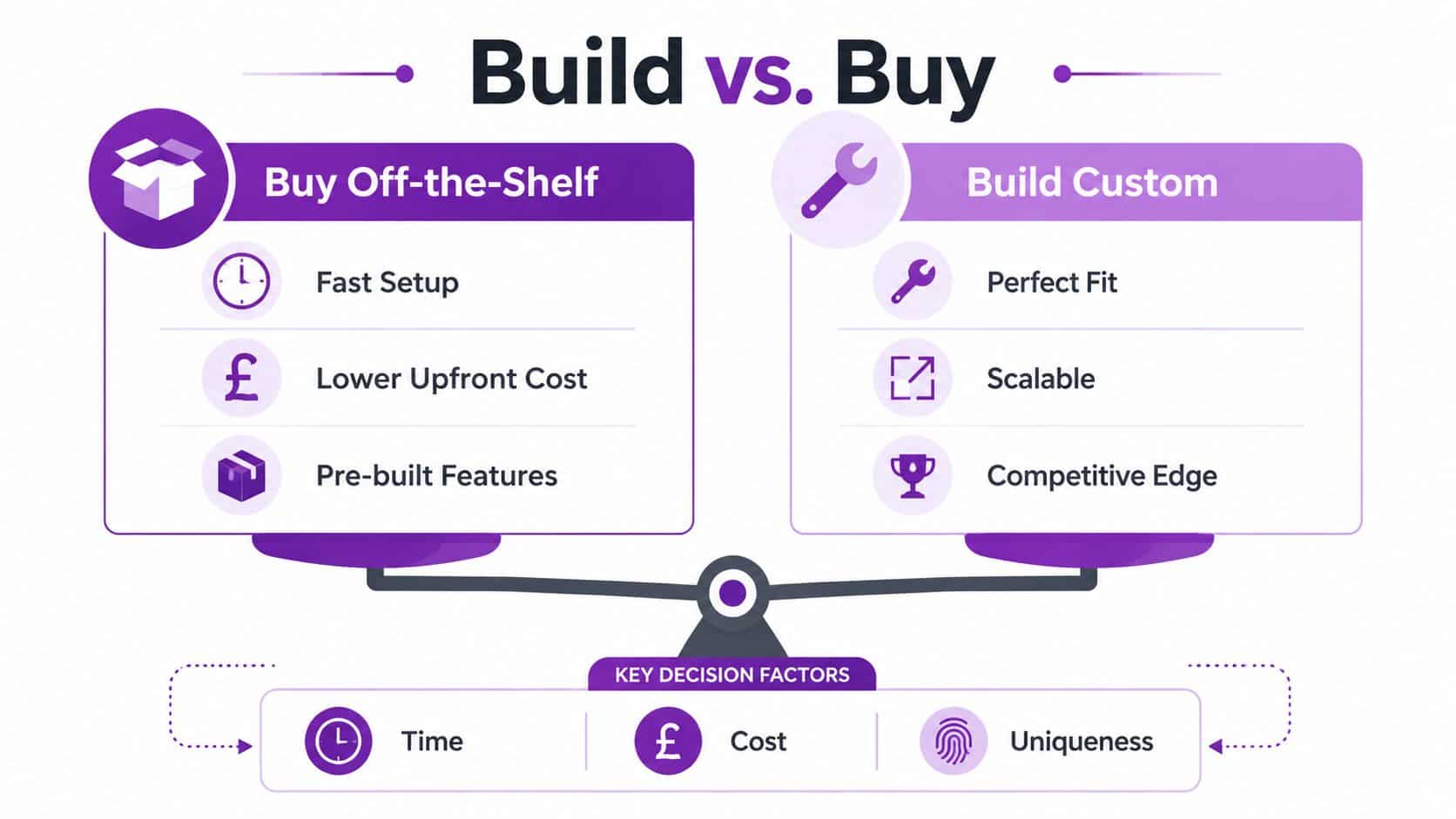
Buying provides speed and familiarity. A subscription product usually includes standard features, vendor updates and established support arrangements. It may be the right choice when the process is common, integration needs are modest and the business doesn't gain an advantage from doing things differently.
Building gives the organisation more control. The team can define the workflow, connect existing tools and prioritise features according to business value. The trade-off is greater responsibility for discovery, testing, security, maintenance and long-term ownership.
Build versus Buy Comparison
| Criteria | Off-the-Shelf Software | Custom Software Development |
|---|---|---|
| Cost | Lower initial commitment, with continuing licence and subscription costs | Greater upfront investment, with ownership and maintenance responsibilities |
| Time | Faster access to established features | Longer route to launch because the system is designed and engineered |
| Flexibility | Processes often need to fit the product | Workflows can reflect the organisation's operating model |
| Integration | Connections depend on available APIs and vendor priorities | Integration can be designed around the required data flow |
| Support | Vendor controls product updates and roadmap | Business chooses its development and support arrangements |
| Strategic value | Suitable for common functions | Can support distinctive processes and competitive differentiation |
Ask three commercial questions
How unusual is the process? If competitors could use the same workflow without changing it, buying may be sensible. If your process reflects specialist manufacturing, regulated case work or a distinctive logistics model, customisation becomes more valuable.
How important is integration? Count the operational hand-offs, not just the number of applications. A business may tolerate a separate invoicing system, but not repeated manual entry between sales, delivery and finance.
What happens as the business grows? A product that works today may become restrictive if new sites, services, customers or reporting obligations require different data flows. Consider the cost of changing platforms later, including migration, retraining and disruption.
A hybrid route often provides the strongest balance. Low-code development using Microsoft platforms can shorten delivery for contained workflows, while targeted code handles the areas where standard configuration stops being practical. The decision should follow the business outcome, not a preference for either “build” or “buy”.
The Custom Software Development Lifecycle Explained
A dependable project makes its decisions visible. Business owners should know what happens at each stage, what they need to approve and which risks the team is addressing before those risks become expensive.
1. Discovery and requirements
The team interviews process owners, observes current work and documents the desired outcome. It should identify users, data sources, permissions, integrations, reporting needs and constraints. The deliverables normally include a prioritised backlog, scope boundaries, an initial architecture view and a risk register.
This stage deserves attention because unclear goals create downstream rework. A UK survey commissioned by Axelos found that 31% of British projects had failed in the prior year. Respondents identified unclear goals at 49%, incomplete risk understanding at 48%, scope changes at 45%, inadequate resourcing at 42%, unrealistic timeframes at 41%, and budget overruns at 32%, as documented in this UK software project rescue analysis.
2. Architecture and design
Architects decide how the application will store data, authenticate users and communicate with Microsoft 365, Dynamics 365, Azure or other services. Wireframes and prototypes let users challenge assumptions before engineers build the complete interface.
3. Build and development
Developers turn prioritised requirements into working increments. Short delivery cycles allow the business to review real functionality, clarify rules and resolve integration issues before the entire system is complete.
4. Testing and quality assurance
Testing should cover business rules, integrations, permissions, data handling and failure scenarios. Automated tests protect repeatable behaviour, while user acceptance testing confirms that the application supports real work.
5. Deployment
Deployment includes environment preparation, data migration, training, operational documentation and a rollback plan. A controlled launch, sometimes starting with a limited group, reduces disruption and gives support staff a clear route for handling issues.
6. Maintenance and evolution
The live application needs security updates, monitoring, defect fixes and planned enhancements. A product roadmap prevents every request becoming an emergency and keeps the system aligned with changing business priorities.
The lifecycle is structured, but it isn't rigid. Requirements can be refined during development, testing can influence design, and architecture may evolve as the team learns more about the data. The discipline comes from recording decisions and controlling change, not from pretending every project follows a perfectly straight line.
UK Custom Software Development Costs and Timelines
UK pricing depends on scope, integration depth, data quality, security requirements and the technology approach. A simple internal tool is around £10,000, while a fully custom enterprise system can exceed £500,000. Most business applications sit between those extremes, with common UK project costs ranging from £30,000 to £150,000 for business web applications and platforms, according to the UK software development cost guide.
UK Custom Software Development Pricing Guide
| Project Type | Typical Cost Range | Estimated Timeline |
|---|---|---|
| Simple internal tool | Around £10,000 | Short, focused delivery |
| Business web application or platform | £30,000 to £150,000 | Dependent on scope and integrations |
| Fully custom enterprise system | More than £500,000 | Extended delivery with multiple workstreams |
These figures are useful for setting an initial budget, not for approving a project without discovery. A portal that reads information from one clean source is a different proposition from a platform that reconciles data across Dynamics 365, finance, warehouse and customer systems. Legacy data, complex permissions and specialist rules can change the work substantially.
A Power Apps solution may reach users sooner than a multi-module application with custom Azure services. That doesn't mean low-code is automatically cheaper in the long term, or that bespoke code is automatically excessive. The right comparison includes licensing, support, integration maintenance, user training and the cost of staff continuing with manual work.
Cost control starts before development
The 2017 Axelos findings make requirements and risk management commercial controls, not administrative extras. A clear acceptance criterion gives the team something testable, while a risk register highlights dependencies such as uncertain data, third-party APIs and limited internal capacity.
Independent UK analysis reported that businesses waste £37bn annually on Agile projects that don't achieve their objectives, with 12% failing completely and nearly one-third failing to some degree, as reported by ITPro's analysis of failed Agile projects. Iteration helps only when the backlog is governed, tests are automated and stakeholders make timely decisions.
A low quote can exclude discovery, migration, testing or support. Bespoke software development services should therefore be assessed by the clarity of the delivery model, not just the headline figure.
Real East Midlands Business Use Cases and Outcomes
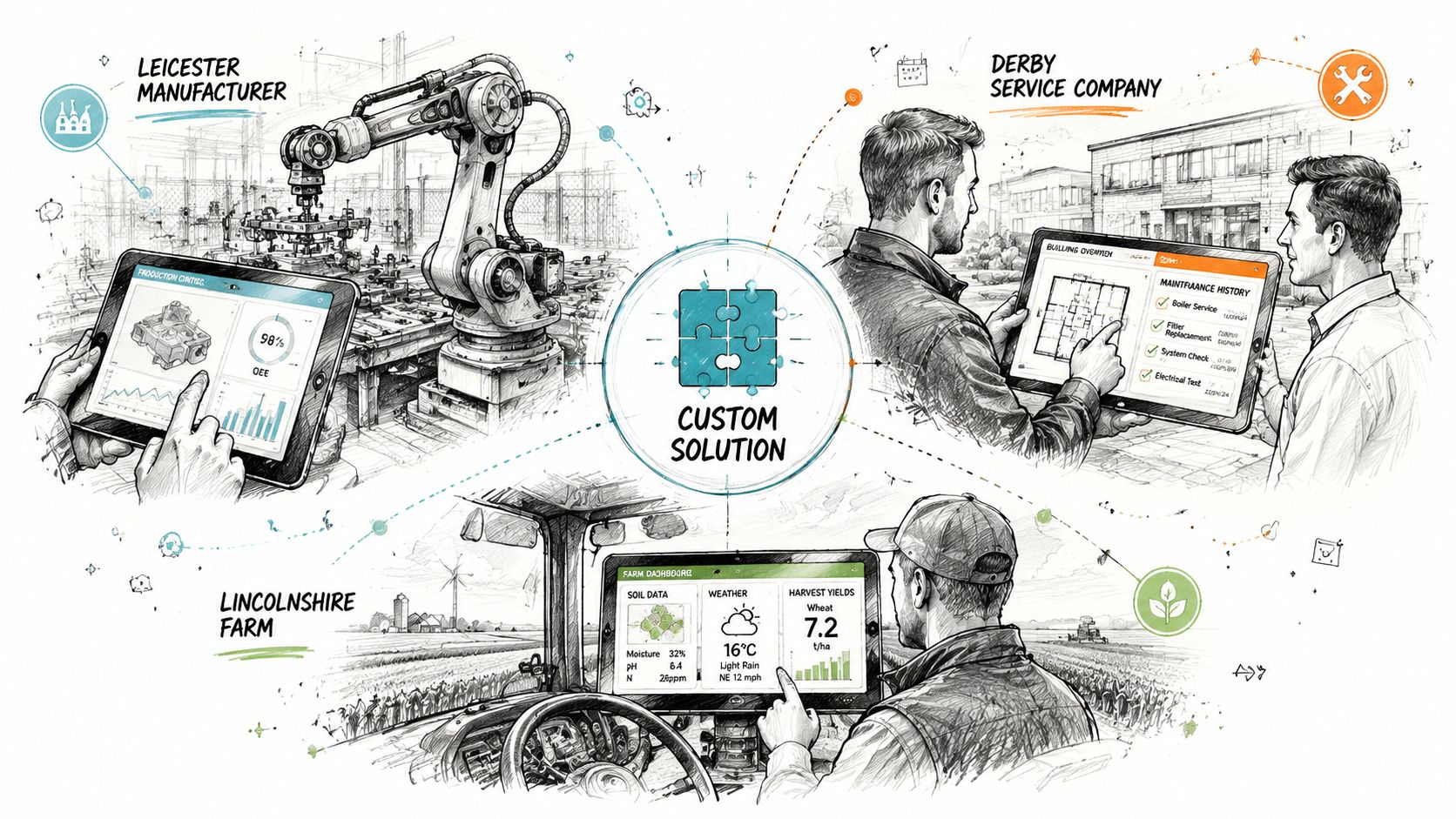
A manufacturer in Lincolnshire may begin with a spreadsheet that records production progress and quality checks. As orders become more complex, staff update different files, supervisors lack a single view and despatch teams wait for confirmation. A custom application connected to Dynamics 365 can bring production status, quality approval and order information into one controlled workflow.
The important outcome isn't the presence of a new screen. It's the removal of uncertainty between the factory floor, office and customer. The application can enforce required checks, preserve an audit trail and expose exceptions for human review.
Logistics near Leicester
A logistics company may have a transport management product, a customer portal and route planning that don't share enough information. A Microsoft-stack solution could use Dynamics 365 for customer records, Power Apps for operational input, Power Automate for notifications and Azure integration services for data exchange.
That architecture doesn't require every function to become a new bespoke product. Custom development belongs where routing rules, delivery windows, vehicle constraints or customer-specific reporting exceed standard configuration. The commercial benefit comes from reducing avoidable hand-offs and giving customers more reliable information.
Professional services in Nottingham
An ageing CRM can force a professional services firm to treat matters, documents, time records and billing as separate activities. A custom case-management application can reflect the firm's actual stages, assign permissions by role and connect approved billing data to its finance process.
These scenarios are representative patterns, not promises of a particular financial return. A credible supplier should define the baseline first, then agree how to measure improvements in administration, errors, response times or revenue opportunity. Without that baseline, “measurable outcome” becomes a slogan rather than a management tool.
How to Choose the Right Custom Software Developer
The supplier's engineering ability matters, but so does its understanding of your operating environment. A technically impressive application can still fail if the developer doesn't understand manufacturing constraints, logistics dependencies, professional services billing or the realities of a small internal IT team.
Use a shortlist that tests delivery quality from several angles:
- Microsoft capability: Ask how the team works with Microsoft 365, Azure, Dynamics 365, Power Apps, Power Automate and Power BI, and which parts require custom code.
- Relevant experience: Request examples involving similar workflows, integrations and user groups. Look for evidence of decisions made, not just attractive screenshots.
- Discovery discipline: Confirm that the supplier documents requirements, assumptions, risks, acceptance criteria and out-of-scope items before quoting the build.
- Communication: Establish who owns product decisions, how progress is demonstrated and how scope changes affect cost or timing.
- Security and governance: Ask about access control, data handling, testing, documentation and any DBS-checked personnel required for your environment.
- Support after launch: Clarify monitoring, incident response, maintenance, enhancement planning and knowledge transfer.
Local knowledge has practical value
An East Midlands partner may provide remote delivery alongside on-site workshops when process observation or user training benefits from being physically present. That flexibility can help teams explain how work happens, including the informal steps that never appear in a process document.
The UK government estimates that the digital skills deficit costs the economy £63bn annually, according to the government's Diversity in UK Tech executive summary. A 2025 government survey found 57% of businesses reported a technical skills gap, with AI concepts and algorithms plus data management among the largest and newest gaps, as detailed in the AI Labour Market Survey 2025.
That evidence changes the buying question. You're not only hiring people to write code. You're securing architecture, data, automation, cyber security and integration judgement that may be difficult to maintain internally.
Your Next Steps and Frequently Asked Questions
Start with an audit of the current operation. List where staff re-enter data, wait for approvals, reconcile records, create spreadsheets or work around vendor limitations. Then describe the business outcomes you need, such as faster order handling, clearer customer visibility or better control over case information.
Next, separate essential capability from attractive extras. Ask a Microsoft-certified development partner to review your existing Microsoft 365, Azure and Dynamics 365 environment, then compare configuration, low-code and bespoke options. The assessment should explain what can remain standard, what needs custom development and how the team will manage data and risk.
Can we begin with a small pilot?
Yes. A focused pilot can test a workflow, integration or user experience before the business commits to a broader platform. Define the pilot's boundary and success criteria in advance, otherwise it can become a disconnected prototype that doesn't inform the main build.
What happens to our existing data and systems?
The development team should map data sources, ownership, quality and dependencies before migration. Systems can remain in operation while interfaces are prepared, with controlled testing and reconciliation before users rely on the new application. Your plan should also explain what happens to the old system, including retention, access and cutover responsibilities.
How does support work after launch?
Support should cover incidents, monitoring, security updates, defect correction and planned improvements. Agree response arrangements, escalation routes and ownership before go-live, and make sure your staff receive documentation and training rather than depending on one developer's memory.
If you're weighing a Microsoft-native solution against custom software development, F1Group can assess your current systems, identify suitable Power Platform, Dynamics 365 and Azure options, and plan bespoke application work where configuration isn't enough. Phone 0845 855 0000 today or contact F1Group to discuss your requirements.