
You’re probably doing this right now. You’re comparing managed IT providers, a Microsoft 365 partner, or a cloud hosting supplier. You’ve checked the price, the service desk hours, the response times, and the contract term. On paper, it looks fine.
But the contract won’t tell you how that supplier behaves when no one is looking. It won’t tell you whether their engineers share admin access carelessly, whether they vet subcontractors properly, whether they report incidents quickly, or whether they can prove who touched your data and when.
That gap is where a supplier code of conduct earns its place. For a UK SMB, it isn’t a corporate tick-box. It’s a practical control for cyber security, resilience, and supplier accountability.
Beyond the Contract The Hidden Risks in Your IT Supply Chain
A standard IT contract usually covers scope, payment, service levels, and liability. Useful, but incomplete. If you’re a growing business in the East Midlands moving email, files, identity, backups, and line-of-business apps into Microsoft 365 or Azure, your supplier is no longer just a vendor. They’re operating inside the systems that keep your business running.
That creates a quiet problem. Your supplier may look competent in the sales process, yet still have weak internal discipline. They might use freelance specialists, outsource monitoring, rely on a third-party data centre, or give support staff broad access with poor oversight. If one of those weak links fails, your business takes the hit.
A service level agreement tells you how fast a supplier should respond. A supplier code of conduct tells you how they’re expected to behave.
This matters well beyond IT. If you’ve read practical guidance on contractors risk management, the principle is the same. The risk doesn’t sit neatly inside the supplier’s business. It crosses into yours through access, process, and dependency.
The risks most SMBs miss
When buyers rely on contract wording alone, they often miss the controls that reduce harm:
- Access discipline: Who can reach your tenant, backup platform, firewall, or remote management tool?
- Incident handling: How quickly must the supplier tell you about a breach, outage, or near miss?
- Subcontractor control: Can the supplier pass work to another firm without your knowledge?
- Data handling: Where is your data stored, moved, viewed, and retained?
- Business continuity: Can the supplier still support you during staff absence, ransomware, or platform disruption?
If you want a broader view of supply chain risk in IT and operations, start there. Then bring that thinking into supplier selection.
Why contracts aren’t enough
A contract is reactive. It helps when something has already gone wrong. A supplier code of conduct is preventative. It sets operating rules before access is granted, before data is shared, and before dependency becomes entrenched.
For managed IT and cloud services, that difference matters. Your biggest supplier risk usually isn’t dramatic misconduct. It’s ordinary bad practice repeated over time until it becomes your problem.
What Is a Supplier Code of Conduct and Why Does It Matter
A supplier code of conduct is a set of house rules for organisations that work with you. It defines the baseline standards you expect before a supplier touches your systems, data, staff, customers, or facilities.
That sounds simple, and it is. The value comes from being specific. If your code says a supplier must protect confidential information, report incidents promptly, manage subcontractors responsibly, and cooperate with assurance checks, you’ve moved from vague expectation to clear control.
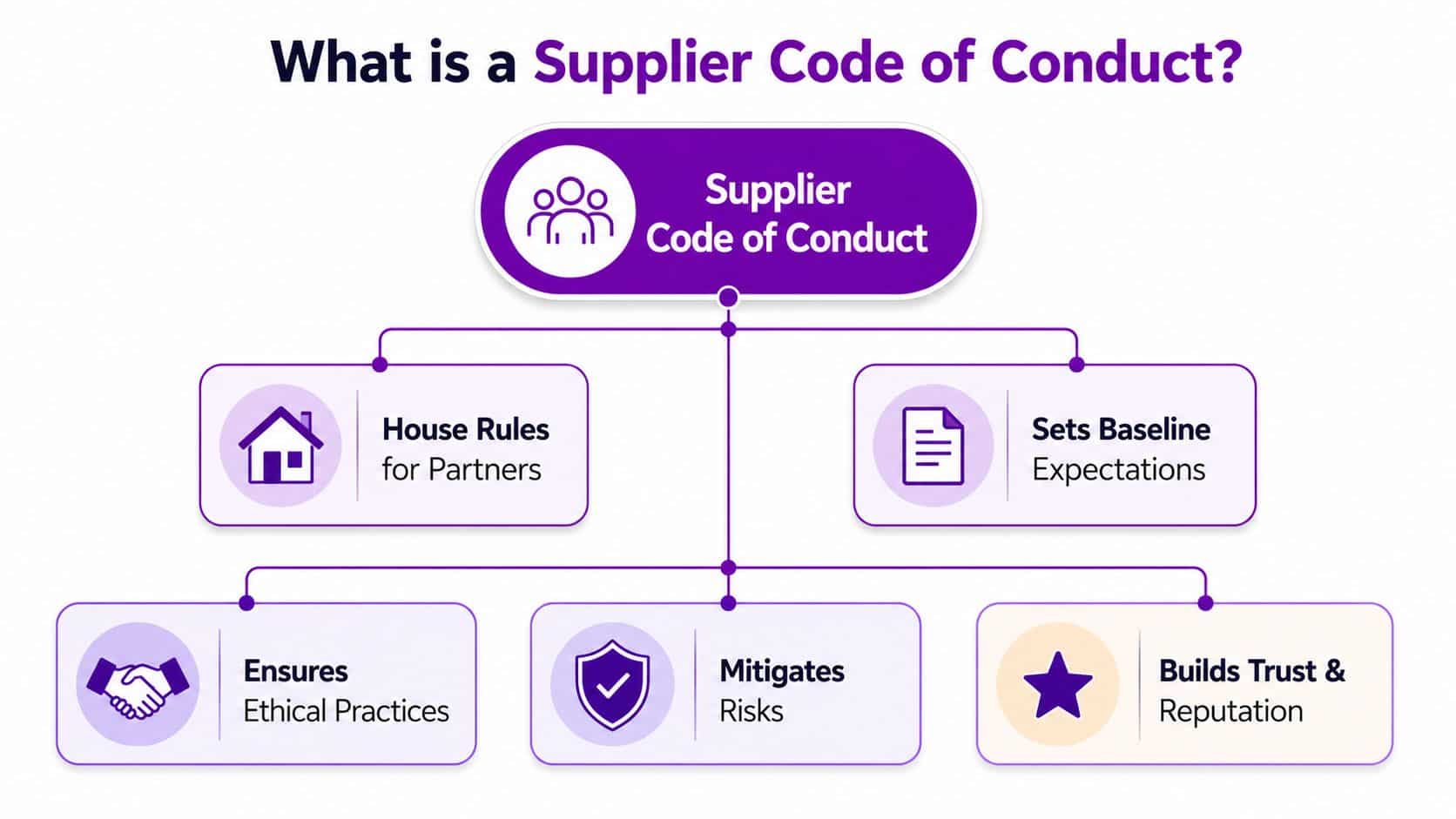
Think of it as house rules with consequences
Most SMBs already apply house rules internally. Staff can’t install whatever they want. Finance approvals follow thresholds. Passwords, access, and devices are governed by policy. A supplier code of conduct extends that same discipline to external partners.
For IT suppliers, the risks are significant because they often have privileged access. They may manage user identities, mailbox content, security tools, cloud platforms, backups, and customer data. If they operate sloppily, your internal controls won’t save you.
Why it matters in the UK
This isn’t an obscure private-sector fad. The UK government’s Supplier Code of Conduct on GOV.UK says suppliers should operate under a clear framework for ethical conduct, transparency, and accountability, and it links expectations to auditability through open-book contracts and published key performance indicators. That matters because central government published procurement spend was £39.7 billion in 2022/23.
The lesson for SMBs is obvious. If supplier standards matter at that scale, they matter when your own business depends on outsourced IT, cloud management, cyber security support, or software development.
What a good code actually does
A useful supplier code of conduct should do three things:
- Set mandatory standards: security, legal compliance, ethical conduct, reporting, subcontractor management.
- Support procurement decisions: suppliers who resist reasonable controls reveal risk early.
- Create evidence: if there’s a dispute, incident, or audit, you can point to agreed expectations.
Practical rule: If a supplier can’t accept clear conduct standards, don’t give them privileged access.
For a UK SMB, that’s the core point. The document isn’t there to look polished in procurement files. It’s there to stop weak suppliers becoming trusted insiders.
Essential Clauses for Your IT Supplier Code of Conduct
Generic templates are a waste of time. If your supplier code of conduct doesn’t deal with cloud administration, data handling, subcontractors, and security reporting, it’s not protecting your business.
The strongest codes are built around measurable obligations. That matters legally as well as operationally. The IBM overview of supplier codes of conduct notes that, for UK procurement teams, a code is materially stronger when tied to measurable legal and ethical benchmarks. It also highlights that the UK Bribery Act 2010 creates corporate exposure where a supplier pays a bribe on your behalf unless your business can show it had ‘adequate procedures’ to prevent it. A code with audit rights is part of that defence.
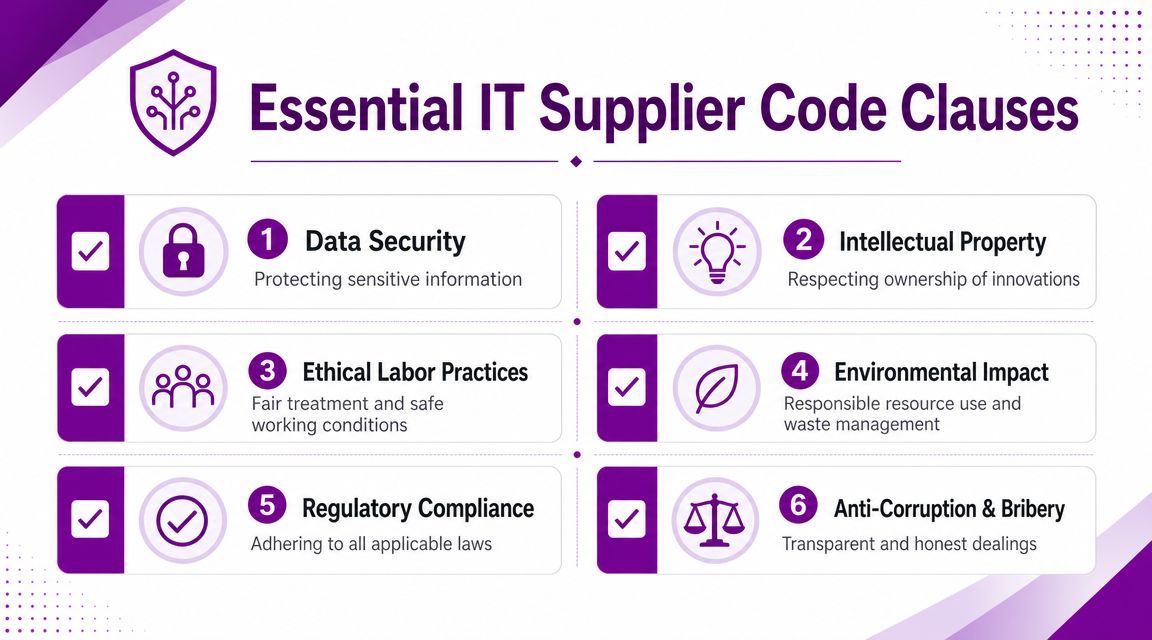
Clauses that belong in every IT supplier code
You don’t need pages of corporate fluff. You do need the right controls.
-
Information security requirements
Require suppliers to protect data, restrict access by role, secure administrator accounts, maintain logging, and apply patching and vulnerability management. If they manage Microsoft 365, Azure, firewalls, endpoints, or backups, say so directly. -
Incident reporting obligations
Set expectations for how suppliers report cyber incidents, suspected compromise, service disruption, and data exposure. Don’t accept vague wording like “within a reasonable time”. -
Subcontractor flow-down
If your supplier uses another provider for hosting, development, monitoring, migrations, support overflow, or field engineering, your standards must flow down to that fourth party. -
Audit and assurance rights
If you can’t verify compliance, the code has no teeth. You need the right to request evidence, review controls, and escalate concerns.
Clauses many SMBs forget
These are often missed, and they matter:
Operational resilience
Ask how the supplier maintains service during staff absence, platform failure, cyber attack, or office disruption. For managed IT and cloud support, resilience isn’t separate from security. It is security.
Data location and handling
Your supplier should tell you where data is stored, who can access it, how it’s transferred, and how long it’s retained. This is especially important when support staff can view live systems or customer records.
Change control
Uncontrolled changes break environments. Your code should require suppliers to document significant technical changes, obtain approvals where appropriate, and keep records.
If a supplier can make privileged changes without traceability, they can also cause damage without accountability.
Don’t leave ethics in a separate bucket
Ethics clauses still matter in IT supplier relationships. They should cover anti-bribery, conflicts of interest, confidentiality, and lawful conduct. They should also be operational. Require training, records, approvals for high-risk payments, and written escalation for suspected breaches.
The right-to-audit clause is the hinge point
A code without a right to audit is just a polite request. You need a clause that lets you ask for evidence, not just promises. That can include policy documents, training records, incident logs, subcontractor lists, assurance responses, and proof that corrective actions were completed.
Without audit rights, buyers end up trusting supplier statements they can’t test. That’s how weak controls survive procurement.
Sample Clause Library for Managed IT Services
Use the table below as a starting point, not a substitute for legal advice. The wording is intentionally plain. The point is to make your expectations clear enough that a supplier can’t pretend they misunderstood.
If you need a broader reference point for drafting governance documents, these IT policy examples are useful alongside legal review.
Sample Clauses for an IT Supplier Code of Conduct
| Clause Category | Objective | Sample Wording (for discussion with legal counsel) |
|---|---|---|
| Data Security | Protect business and customer information | Supplier must protect all client data using appropriate technical and organisational controls, restrict access to authorised personnel only, and maintain records of privileged access. |
| Incident Reporting | Ensure rapid visibility of security and service issues | Supplier must notify the client promptly of any actual or suspected security incident, data exposure, service compromise, or unauthorised access affecting client systems, data, or operations. |
| Subcontractor Flow-Down | Control fourth-party risk | Supplier must not appoint subcontractors to deliver services involving client data, systems, or support obligations unless the subcontractor is bound by equivalent contractual, security, and conduct requirements. |
| Access Control | Limit misuse of privileged rights | Supplier must allocate administrator access on a least-privilege basis, review access regularly, and remove access promptly when no longer required. Shared privileged accounts should be avoided unless formally approved and logged. |
| Audit Rights | Allow verification of compliance | Supplier must retain evidence of compliance and provide reasonable cooperation with client assurance reviews, including policies, procedures, records, and remediation evidence where relevant to the services provided. |
| Business Continuity | Reduce operational disruption | Supplier must maintain and test business continuity arrangements appropriate to the services, including contingency plans for staff absence, cyber incidents, and service disruption. |
| Change Management | Prevent unauthorised or unsafe technical changes | Supplier must document material changes to managed systems, obtain required approvals, and retain change records sufficient to support review and incident investigation. |
| Anti-Bribery and Ethics | Reduce legal and reputational exposure | Supplier must comply with applicable anti-bribery laws, maintain appropriate internal controls, disclose conflicts of interest, and report any suspected unethical conduct connected with the services. |
| Confidentiality | Protect sensitive commercial and technical information | Supplier personnel must keep client information confidential, use it only for authorised purposes, and return or securely delete it when no longer required. |
| Compliance and Escalation | Make breaches actionable | Supplier must report any breach of this code, cooperate in investigation, and implement corrective actions within agreed timescales. Repeated or material non-compliance may lead to suspension or termination. |
How to use these clauses properly
Don’t drop this table into a procurement pack and hope for the best. Shortlist the clauses that match the service risk. A payroll software partner doesn’t need the same depth as a managed security provider with tenant-wide administrative access.
Also, keep the wording aligned with your contracts, onboarding forms, and supplier review process. If one document says audit is allowed and another makes it impossible in practice, your supplier will default to the weaker position.
How to Implement and Enforce Your Code of Conduct
A supplier code of conduct only works when procurement, IT, operations, and leadership use it the same way. If it sits on your website or in a shared folder, it has no practical value.
The implementation model should be simple. Draft it, issue it, test it, enforce it.
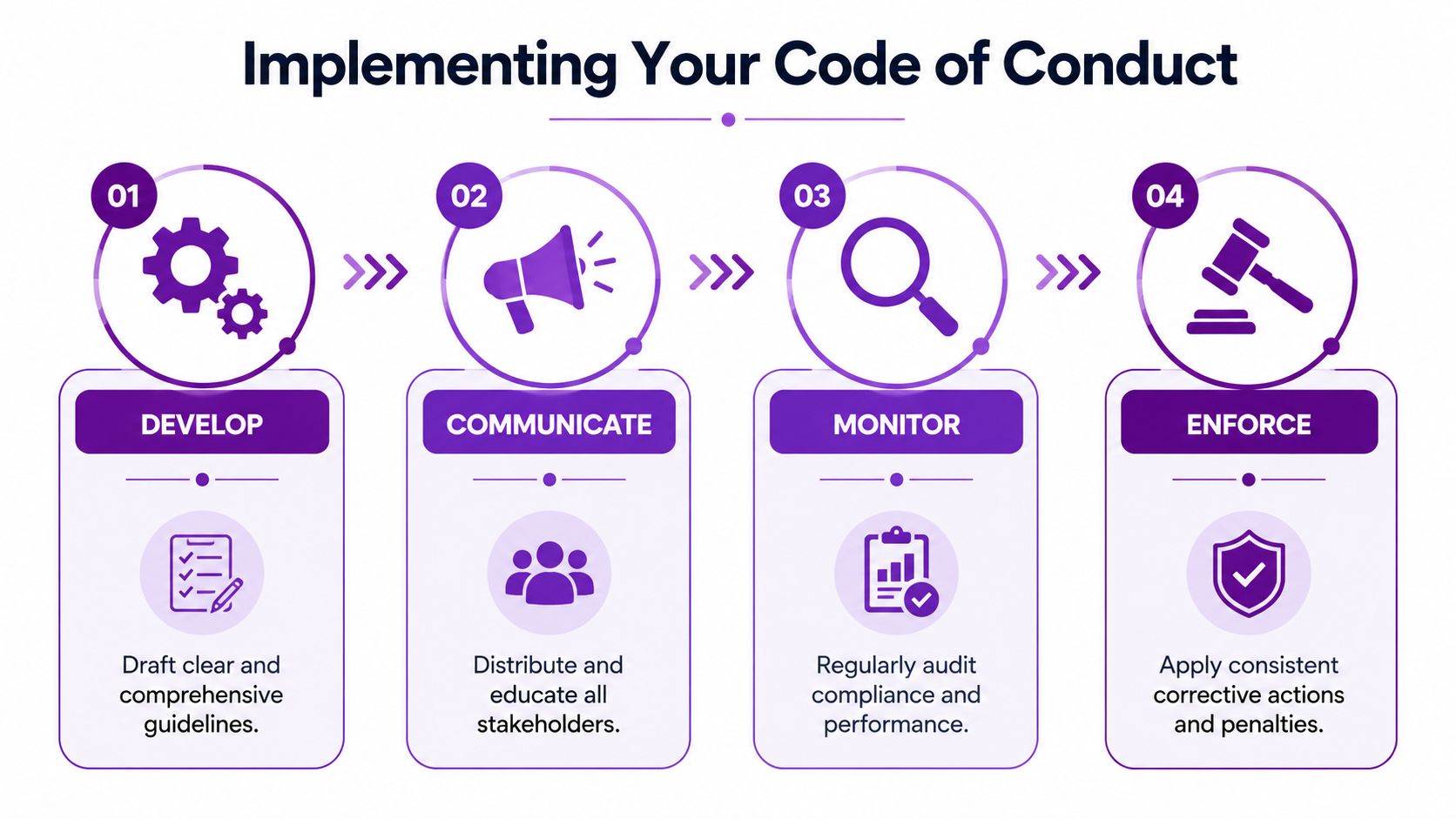
Step one: build it into procurement
Make acceptance of the code part of supplier selection, not an afterthought after signature. Include it in your tender pack, onboarding checklist, and contract issue process. If you’re formalising supplier selection, an IT RFP template helps tie conduct standards to technical and commercial questions.
For higher-risk suppliers, ask for supporting evidence. That might include policy summaries, incident response arrangements, subcontractor details, assurance responses, or control statements relevant to the service.
Step two: classify suppliers by risk
Treating every supplier the same wastes time. A stationery supplier doesn’t need the same scrutiny as a managed Microsoft 365 partner or outsourced service desk.
Use a simple model:
- High risk: suppliers with admin access, customer data access, hosting responsibility, security monitoring, or business-critical support.
- Medium risk: suppliers with limited system access or indirect exposure to important information.
- Low risk: suppliers with no material access to systems or sensitive data.
This lets you decide who signs the code, who completes due diligence, and who goes through periodic review.
Step three: verify, don’t just collect signatures
The Greenly summary of supplier code practice notes that, in the UK, a key driver is supply-chain due diligence under the Modern Slavery Act 2015, which requires certain large organisations to report on supply chain risks. The practical lesson applies more widely. An effective code needs auditable controls and escalation rules for non-compliance. Passive agreement isn’t enough.
Verification can include:
- Annual assurance questionnaires
- Evidence requests for key controls
- Review of incident and remediation history
- Confirmation of subcontractor use
- Management sign-off for exceptions
Weak suppliers usually don’t fail at signing documents. They fail when asked for evidence.
Step four: enforce consistently
Your enforcement path should be firm and predictable:
- Record the breach and confirm the facts.
- Issue a formal notice describing the non-compliance.
- Require a remediation plan with named actions and deadlines.
- Escalate if needed, including service restrictions, senior review, or termination.
Don’t threaten sanctions you won’t use. Suppliers learn quickly which clients mean what they say.
Common Pitfalls and How to Avoid Them

The biggest mistake is treating a supplier code of conduct as a brand document. It isn’t there to display your values in polished language. It’s there to control supplier behaviour in areas that can damage your business.
That mistake shows up in several ways.
Pitfall one: using a generic template
A generic code usually talks about labour, environment, and anti-corruption in broad terms. Fine, but incomplete. For managed IT and cloud suppliers, you need clauses on admin access, incident notification, subcontractors, resilience, and data handling. If those aren’t there, your highest risks are untouched.
Pitfall two: confusing disclosure with maturity
The S&P Global analysis of supplier code disclosures found that 51% of applicable companies publicly disclosed a supplier code of conduct in 2024, up from 45% the year before. That’s a 6 percentage-point increase. It also found notable gaps, with many codes stronger on environmental topics than on operational or cyber security requirements.
The point is blunt. Having a code isn’t proof that the code is good.
Pitfall three: ignoring fourth-party risk
Your supplier may meet your standards personally while using subcontractors that don’t. If your code doesn’t require flow-down obligations, approval controls, and visibility of third-party involvement, you’ve left a hole in the fence.
Pitfall four: never updating it
A supplier code of conduct should change as your environment changes. If you move into Azure, adopt Copilot, outsource more support, or depend more heavily on cloud platforms, your supplier rules should evolve as well.
Review the code when your technology model changes, not just when legal asks for an annual refresh.
Secure Your Supply Chain Your Next Steps
A supplier code of conduct is one of the simplest ways to improve supplier accountability without adding pointless bureaucracy. It gives your business a clear standard for how IT and cloud suppliers should operate before they gain trust, access, and influence.
For UK SMBs, that matters because outsourced technology support is now tied directly to business continuity, customer confidence, and cyber resilience. Your systems may sit in Microsoft 365, Azure, a hosted application stack, or a managed backup platform. Even so, the operational risk doesn’t disappear. It shifts into your supplier chain.
The right move is practical, not theoretical.
Start with these actions
- List your key IT suppliers: managed service providers, cloud partners, software support firms, hosted platform vendors, cyber security specialists.
- Rank them by access and criticality: who can affect your operations fastest?
- Draft or revise your supplier code of conduct: focus on security, incident reporting, subcontractors, resilience, audit rights, and ethics.
- Make acceptance part of procurement and renewal: don’t leave it optional.
- Test for evidence: ask higher-risk suppliers to prove they operate the way they claim.
If you want to improve supplier governance, start with the providers who can access your data, your identities, or your infrastructure. That’s where the greatest concentration of risk resides, and that’s where the damage usually starts when controls are weak.
If you need help turning a supplier code of conduct into a practical control for managed IT, Microsoft 365, Azure, cyber security, and cloud procurement, speak to F1Group. We can help you assess supplier risk, tighten procurement requirements, and build workable standards that protect your business. Phone 0845 855 0000 today or send us a message.